Is Ovulation the Only Time You Can Get Pregnant?
- Medically Reviewed
- Last Updated
The short answer is no—while ovulation is the time when conception is most likely, pregnancy can potentially happen outside of that exact moment due to biological variability.
Understanding ovulation can make all the difference—whether you’re trying to get pregnant or avoid it. Here’s how the fertile window works, when pregnancy is possible, and what most people get wrong.
Want to know for sure?
Schedule an appointment with Ava for a free pregnancy test and know for sure whether you’re pregnant.
What is ovulation?
Ovulation is the moment in a menstrual cycle when a mature egg is released from the ovary into the fallopian tube.
That egg remains viable for fertilization for approximately 12 to 24 hours.
Ovulation typically occurs around the midpoint of a regular 28–day cycle—around Day 14, though the exact timing varies per person and per cycle.
Tracking ovulation can be helpful, for lots of reasons. Signs to monitor include:
- Basal Body Temperature (BBT): Small rise post–ovulation
- Cervical mucus: Becoming clear and stretchy near ovulation
- LH surge tests: Detect impending ovulation via urine kits
When am I fertile?
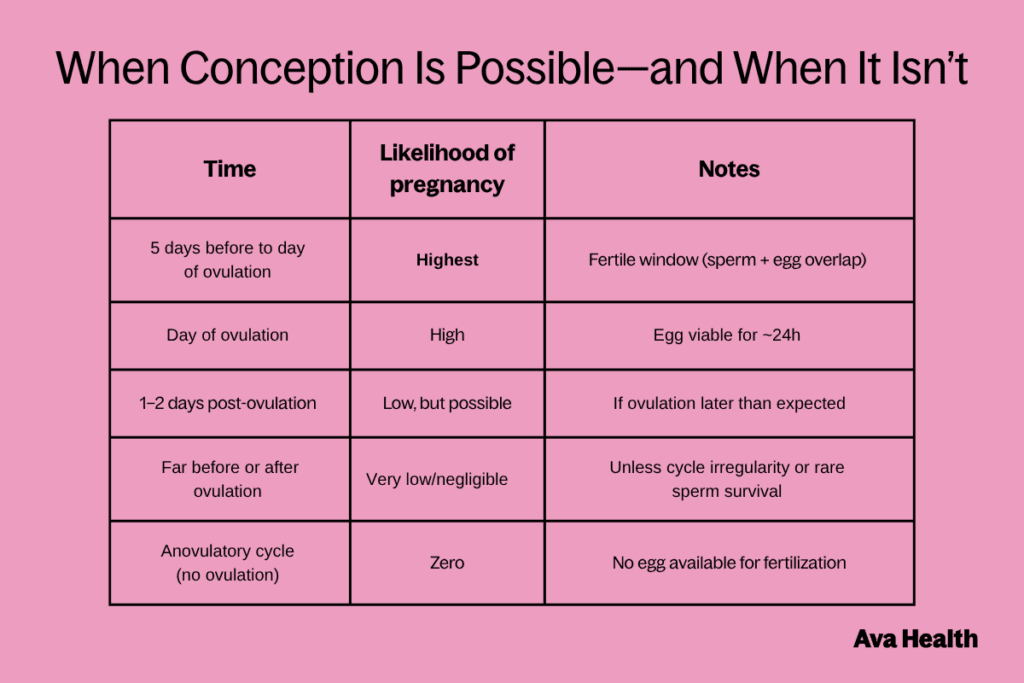
The “fertile window” typically spans about six days: the five days before ovulation and the day of ovulation itself.
Why six days? Because:
- Sperm can survive in the reproductive tract for up to 5 days, especially when cervical mucus is optimal.
- The egg lives about 12–24 hours after release.
This overlap makes the days leading up to ovulation the most fertile—even more so than the ovulation day itself.
Can you get pregnant when you're not ovulating?
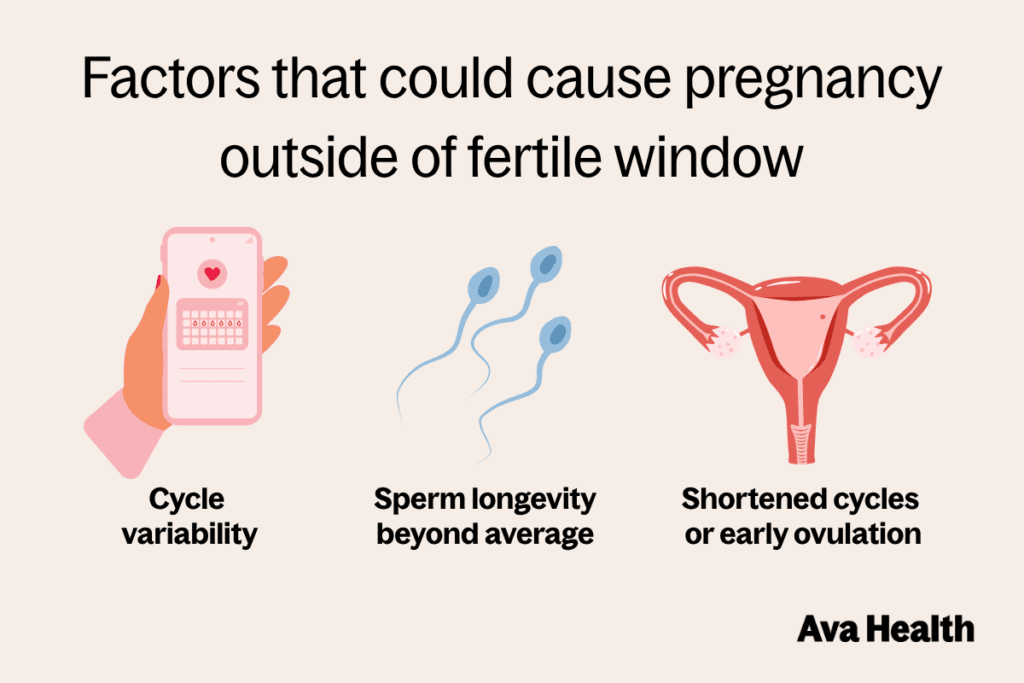
Although the fertile window marks the highest chance of conception, the answer is yes—but very unlikely—that pregnancy can occur outside of it, due to several factors.
- Cycle variability
Ovulation timing can vary from cycle to cycle—even in someone with regular periods. - Sperm longevity beyond average
While 5 days is typical, rare reports suggest sperm survival up to 15 days, though this is exceptional. - Shortened cycles or early ovulation
If someone has a brief cycle, sex at the end of the period could result in pregnancy if ovulation happens shortly after.
Nevertheless, no pregnancy can occur without ovulation, because there’s no egg to fertilize.
Might be pregnant?
Even if you understand how ovulation works, it’s still possible to feel unsure—especially if something about your cycle feels different this month.
Many women come here looking for clarity, only to realize they still have questions about what’s actually happening in their body.
If you’re wondering whether you could be pregnant, the next step isn’t guessing—it’s getting a clear answer.
Can I get pregnant during my period?
- During menstruation
Typically low chance—but if ovulation occurs early and sperm survive, conception is possible.
- Immediately after period
The risk rises, especially with early ovulation and long sperm lifespan.
- Late in the cycle (just before next period)
Generally unlikely, unless there’s delayed ovulation or extended sperm survival.
5. TL:DR: Key Takeaways
- There’s only a chance of getting pregnant when an egg is released and there’s sperm to meet it; Timing of when this egg is released and when sperm are still viable are more complex.
- Your highest chance of getting pregnant is 5 days before ovulation.
- If you’re concerned about possibly being pregnant, get a free pregnancy test at Ava Health to know for sure.
How to avoid pregnancy
Use barrier or hormonal contraception in addition to awareness methods. Awareness alone has typical failure rates around 11–34%.
Remember that:
- Hormonal birth control suppresses ovulation
- Non-hormonal methods block sperm
If you're concerned about being pregnant
If there’s a chance you could be pregnant, it’s normal to feel unsure about what to do next.
You might be asking questions like:
- “What are my options?”
- “How far along would I be?”
- “What happens next?”
Getting real answers can help you move forward with confidence.
FAQs
Will I 100% get pregnant while ovulating?
No. There are several factors that have to line up in order for pregnancy to happen and according to research, there’s only a 42% chance that pregnancy will happen during your fertile window.
How do I know if i'm fertile?
If you haven’t been tracking, and you have a typical cycle length ranging from 21-35 days, ovulation will typically happen right in the middle of your cycle (day 10-12 if your cycle is 21 days, and day 16-18 if your cycle is 35 days). Some signs of ovulation are:
– Slippery, stretchy discharge (like egg whites)
-Mild, one-sided pelvic pain
-Light spotting
-Rise in BBT (Basal Body Temperature)
What do I do if I don't want to get pregnant but i'm ovulating?
If you don’t want to get pregnant, the only 100% sure method to avoid pregnancy is abstinence; however, ensuring the use of one or more contraceptive methods or taking regular birth control can also reduce the chance of pregnancy.
Sources:
- Wilcox, Allen J., David Dunson, and Donna Day Baird. “The Timing of the ‘Fertile Window’ in the Menstrual Cycle: Day-Specific Estimates from a Prospective Study.” BMJ, vol. 321, no. 7271, 18 Nov. 2000, p. 1259, doi:10.1136/bmj.321.7271. https://musc.edu/mbes-ljg/Courses/Biology%20of%20Reproduction/Paper%20pdfs/Wilcox%20fertile%20window.pdf?utm_source=chatgpt.com
Ecochard, René, Christian Gnoth, and Bernardo Colombo. “Mucus Observations in the Fertile Window: A Better Predictor of Conception Than Timing of Intercourse.” Human Reproduction, vol. 19, no. 4, April 2004, pp. 889-892, doi:10.1093/humrep/deh173. https://academic.oup.com/humrep/article/19/4/889/2913645?utm
Fehring, Richard J., et al. “Fertility Awareness-Based Methods for Women’s Health and Reproductive Planning.” Frontiers in Medicine, vol. 9, 2022, article 858977, doi:10.3389/fmed.2022.858977. https://www.frontiersin.org/journals/medicine/articles/10.3389/fmed.2022.858977/full?utm_
Yu, Jia-Le, Yun-Fei Su, Chen Zhang, Li Jin, Xian-Hua Lin, Lu-Ting Chen, He-Feng Huang & Yan-Ting Wu. “Tracking of Menstrual Cycles and Prediction of the Fertile Window via Measurements of Basal Body Temperature and Heart Rate as Well as Machine-Learning Algorithms.” Reproductive Biology and Endocrinology, vol. 20, article 118, 13 Aug. 2022, doi:10.1186/s12958-022-00993-4. https://rbej.biomedcentral.com/articles/10.1186/s12958-022-00993-4?utm_
Ren, Yue, Yue Xie, Qulian Xu, Miaochen Long, Ying Zheng, Lin Li & Changmin Niu. “University Students’ Fertility Awareness and Its Influencing Factors: A Systematic Review.” Reproductive Health, vol. 20, article 85, 6 June 2023, doi:10.1186/s12978-023-01628-6. https://reproductive-health-journal.biomedcentral.com/articles/10.1186/s12978-023-01628-6?utm_
Bruce, James, et al. “Fertility Awareness-Based Methods of Family Planning.” Contraception, vol. 100, no. 5, 2019, pp. 272-285. https://www.sciencedirect.com/science/article/pii/S1521693419301798?utm_
Share this Blog
Disclaimer: The content on this site is for informational purposes only and does not constitute medical advice. Ava Health does not refer for or perform abortions. All medical information is accurate at the time of publishing.
Medically Reviewed By:

Anka Radutiu, BSN, RN
Other Articles You Might Be Interested In


I Think I Might Be Pregnant: What to Do Before You Take a Test