
What are the different types of abortion?
- Medically Reviewed
- Last Updated
Before taking the abortion pill or going to a clinic for an abortion, it’s important to know all the facts about your decision. In the following article, we will discuss the different types of abortion, their risks, who should not have an abortion, and important things to watch out for.
What is the abortion pill? (Taken up to 10 weeks of pregnancy)
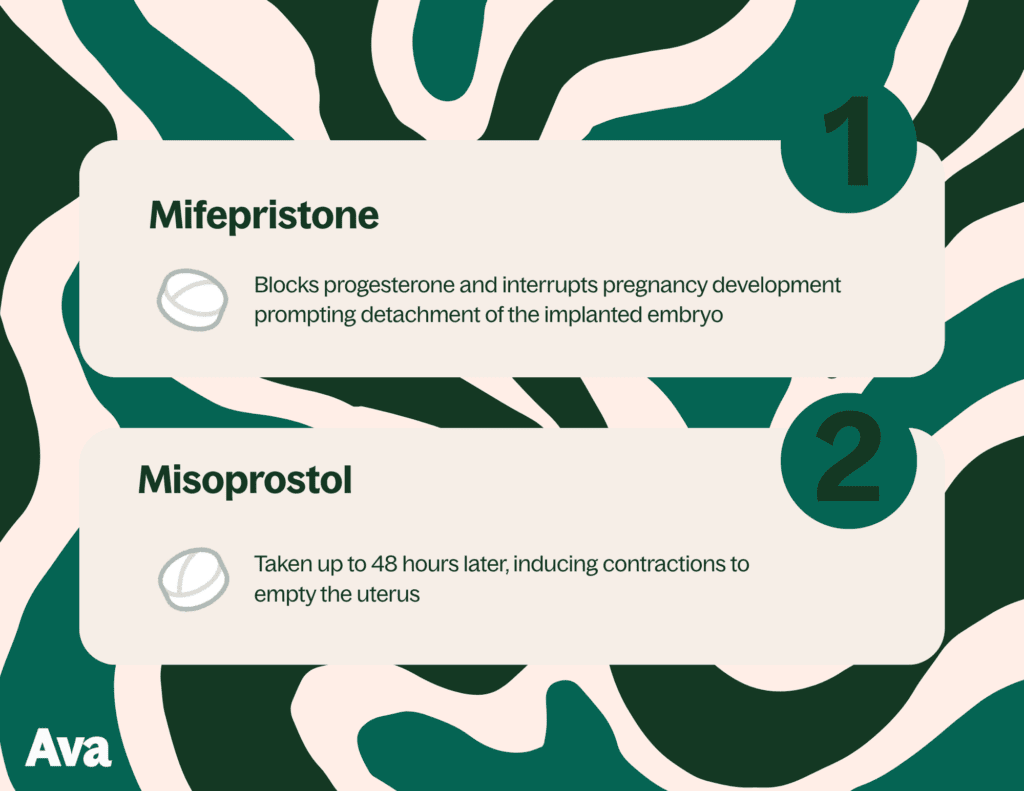
The abortion pill induces a chemical/medication abortion. It involves 2 medications:
- The first medication is Mifeprex, which blocks progesterone and interrupts pregnancy development prompting detachment of the implanted embryo.
- Secondly, Misoprostol is taken up to 48 hours later, inducing contractions to empty the uterus.
Women who take the abortion pill report experiencing cramping, bleeding, nausea and vomiting.
Because 8%-10% of women will require a surgical abortion to complete the process after taking the pill, it’s best to have an in-clinic follow up afterwards to ensure no complications or leftover tissue.
What are the risks of the abortion pill?
- Abortion Failure (Incomplete Abortion)
- Bleeding & Hemorrhage
- Infection (RU-486 suppresses the immune system)
- Severe Pain/Cramping
- Nausea
- Vomiting
- Diarrhea
- Fever
- Chills
- Headache/Dizziness
Who should not take the abortion pill?
The abortion pill is not advised for women who have:
- Anemia
- Bleeding disorders
- Liver or kidney disease
- Seizure disorder
- Acute inflammatory bowel disease
- An intrauterine device
Caution: Do Not Buy Mifeprex Over the Internet
You should not buy Mifeprex over the Internet because you will bypass important safeguards designed to protect your health. Mifeprex has safety restrictions on how it is distributed to the public. In addition, drugs purchased from foreign Internet sources are not the FDAapproved versions of the drugs, and they are not subject to FDA-regulated manufacturing controls or FDA inspection of manufacturing facilities.
Other Types of Abortions
Manual Vacuum Aspiration (7 weeks after your last period)
The cervix is stretched with dilators wide enough to allow the abortion instruments to pass into the uterus. A hand held syringe is attached to tubing that is inserted into the uterus and the fetus is then suctioned out.
Suction Curettage (This is the most common abortion type, 6 weeks after your last period up to 17 weeks)
The cervix is opened with a dilator up to 14 weeks. The doctor inserts tubing connected to a suction machine into the uterus. The suction pulls the fetus body apart and empties the uterus. Between 14 weeks and 16 weeks 6 days, the cervix will be softened by giving Misoprostol, orally or vaginally, so dilation is easier for the larger fetus.
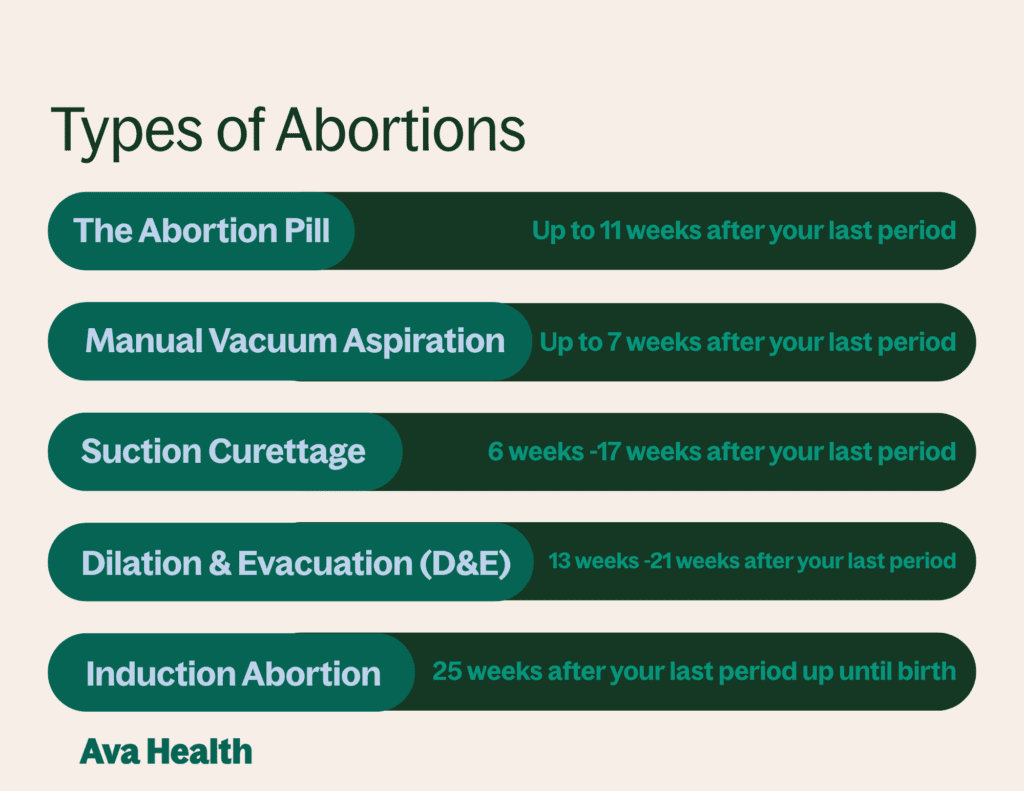
Dilation & Evacuation ("D&E," 13 weeks after your last period up to 21 weeks)
In this procedure, the cervix is softened by giving Misoprostol, orally or vaginally, so cervix can be opened wider than in a first trimester abortion, allowing the doctor to pull out the fetal parts by combination of suction, curette and/or with forceps. The fetus skull is crushed to ease removal.
Induction Abortion (Late-Term Abortion, 25 weeks after your last period up to birth)
A lethal dose Digoxin is injected into the fetus heart or amniotic fluid initiating a fatal heart attack. The cervix is treated for 2-3 days to prepare the deceased fetus for delivery. On the final day, the woman is given Oxytocin to induce labor leading to vaginal delivery.
What are the risks of abortion?
- Heavy or continued bleeding
- Infection
- Sepsis (infection entering blood)
- Incomplete abortion
- Allergic reaction to drugs
- Damage to cervix
- Scarring of uterine lining
- Perforation (causing a hole) of the uterus
- Damage to internal organs
- Rarely, death
Abortion is linked to subsequent preterm births and increased risk for placenta previa and mental health issues.
Does abortion affect my fertility?
Scarring or other injury during an abortion may prevent or place at risk future wanted pregnancies.
What do I do next if i'm thinking about abortion?
The first thing to do if you are considering abortion is to confirm your pregnancy with an in-clinic pregnancy test. Our tests are medical grade and 99% accurate, and a nurse can interpret your results– no more guessing!
Secondly, get an ultrasound to determine how far along you are. Without knowing this information, even if you’re slightly off, will determine which abortion method will be the most effective.
Lastly, if you haven’t been tested for STI’s recently, it’s time to get tested before an abortion. Without this test, there is a risk of an asymptomatic STD spreading during an abortion and causing Pelvic Inflammatory Disorder, which can lead to future infertility.
Sources
American Pregnancy Association. American Pregnancy Association, https://americanpregnancy.org/. Accessed 6 Apr. 2026.
U.S. Food and Drug Administration. U.S. Food and Drug Administration, https://www.fda.gov/. Accessed 6 Apr. 2026.
Live Action. “What Is Abortion?” Live Action, https://www.liveaction.org/what-is-abortion. Accessed 6 Apr. 2026.
NHS inform. “Types of Abortion.” NHS inform, https://www.nhsinform.scot/tests-and-treatments/non-surgical-procedures/abortion/types-of-abortion/. Accessed 6 Apr. 2026.
Share this Blog
Disclaimer: The content on this site is for informational purposes only and does not constitute medical advice. Ava Health does not refer for or perform abortions. All medical information is accurate at the time of publishing.
Medically Reviewed By:

Anka Radutiu, BSN, RN
Other Articles You Might Be Interested In


I Think I Might Be Pregnant: What to Do Before You Take a Test