
- Ava Health
It’s completely natural to feel unsure or even nervous when thinking about how often you should get tested for sexually transmitted infections (STIs). If you’re reading this, you’re taking a thoughtful step toward caring for your health, and that’s a good thing! You don’t have to face this alone, and you deserve accurate information delivered with compassion.
Table of Contents
What to Know: Understanding STI Testing and How Often You Should Get Tested
Why regular STI testing matters
Getting tested for STIs is a key part of protecting your health and preserving your future well-being. Infections that go undetected and untreated can lead to complications—some serious, some subtle. Having a clear picture of your status helps you make empowered decisions, maintain respectful relationships, and plan for whatever comes next.
Understanding that helps you set expectations and act wisely rather than waiting in uncertainty.
What to consider when deciding testing frequency
Here are some important factors to help you think about how often you should get tested for STIs:
- Number of sexual partners: The more partners (or new partners) you have, the higher the chance of exposure.
- Type of sexual activity: Vaginal, anal, and oral sex each carry varying levels of risk for different infections.
- Protection use: Consistent condom use, dental dams, and other barrier methods reduce risk—but only abstinence is 100 % protective
- Known exposures: If you’ve had unprotected sex or your partner(s) had an STI, earlier or more frequent testing may be warranted.
- Symptoms: Some STIs show symptoms (e.g., unusual discharge, burning with urination, lower-abdominal pain) but some do not.
- Routine care: Even without symptoms or obvious “risk moments,” getting a regular check-in on your sexual health is a great preventative step.
What the guidelines suggest
The CDC suggests the following general cadence:
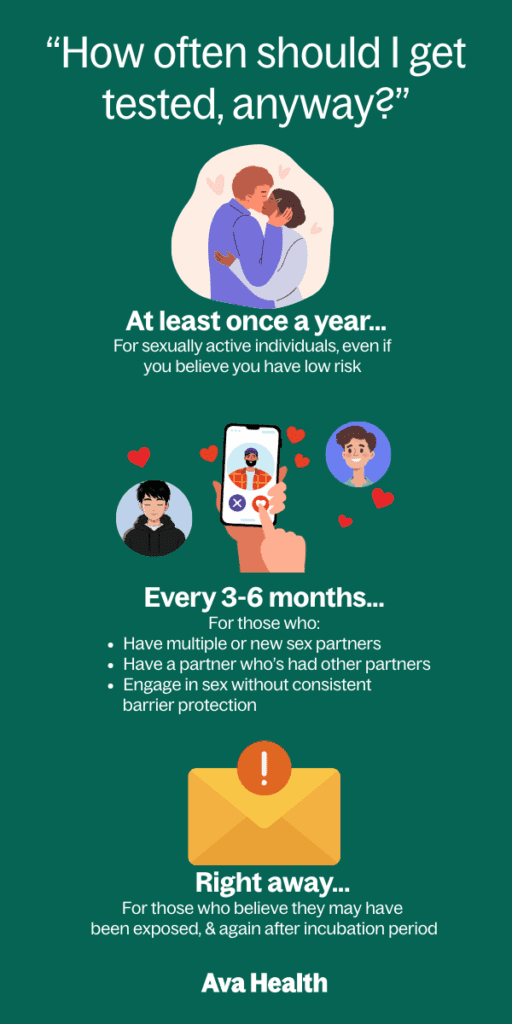
- At least once a year for sexually active individuals, even if you think your risk is lower.
- More frequently (approximately every 3-6 months) if you:
- Have multiple or new sexual partners
- Have a partner who’s had other partners
- Engage in sex without consistent barrier protection
- Right away if you suspect you may have been exposed (unprotected sex with a new partner, a partner with an STI, etc.). Then again after the appropriate incubation window.
The “window period” is critical: for many bacterial STIs like chlamydia and gonorrhea, waiting at least 21 days after exposure is recommended before testing.
What to know about the process
When you get tested, here’s what to expect:
- At Ava Health, testing is free, confidential, and “judgment-free” for those assigned female at birth able to do a vaginal self-swab.
- The time it takes to receive results depends on the lab and test type. At Ava, we’ll give you an estimate as part of your visit.
- If a result is positive, treatment and partner notification/management become important. Early treatment can prevent complications like pelvic inflammatory disease (PID) or infertility.
- After treatment, re-testing may be recommended (for example 3-4 months after finishing treatment) even if you believe your partner(s) were treated.
Why more frequent testing can be wise
- Some infections don’t show symptoms, meaning you might unknowingly pass them to a partner.
- If you’re sexually active with new or multiple partners over time, more frequent testing helps you stay ahead of any potential issues.
- Early detection often makes treatment easier, less costly (emotionally and physically), and helps safeguard your long-term fertility and health.
- Being proactive also reduces anxiety—you won’t have to carry “what if” questions around in your mind.
A Moment to Breathe
Taking charge of your sexual health is an act of kindness toward yourself and your body. By choosing to get tested, you’re showing wisdom and care for the relationships you engage in. If you find yourself in a situation you didn’t anticipate, or worry you may have been exposed, it doesn’t mean your worth is less.
Remember that your story is not defined by a single test result or incident. It’s defined by how you respond, care for yourself, and support your well-being moving forward, using information as a way to make empowered decisions.
Reflection: Questions You Can Ask Yourself
Take a moment to pause, breathe, and reflect. You don’t have to rush anything. These questions are here to help you tune into what your needs might be:
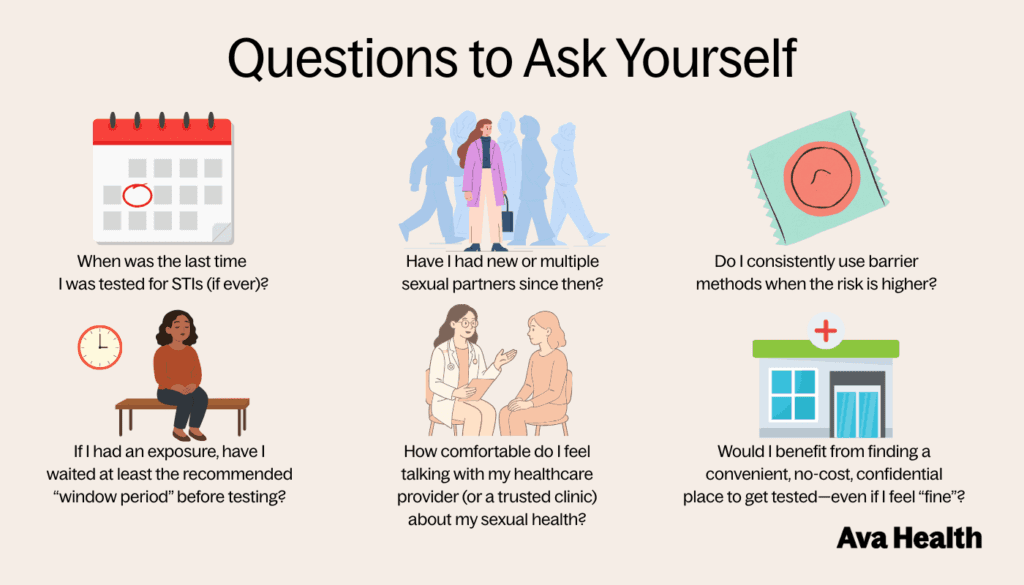
- When was the last time I was tested for STIs (if ever)?
- Have I had new or multiple sexual partners since then?
- Do I consistently use barrier methods (condoms, dental dams) when the risk is higher?
- If I had an exposure (unprotected sex, partner with unknown STI status), have I waited at least the recommended “window period” before testing?
- How comfortable do I feel talking with my healthcare provider (or a trusted clinic) about my sexual health?
- Would I benefit from finding a convenient, no-cost, confidential place to get tested—even if I feel “fine” and have no symptoms?
Answering honestly can guide you toward choices aligned with your health and peace of mind.
Practical Next Steps & Support
Here are some actionable steps you might take now:
- Consider scheduling an STI screening appointment at a place like Ava Health: they provide free, confidential STI testing and treatment for those assigned female at birth who can vaginally self‐swab.
- If you’ve had unprotected sex or a new partner recently, plan to wait the recommended 21 days before testing (or ask the clinic what they suggest) to ensure accurate results.
- Set a recurring reminder (every 3–12 months) to check in on your sexual health—just like you might with a dental cleaning or routine health exam.
- Talk openly with partners about STI testing, safer sex practices, and what both do if a result comes back positive. Remember: communication is healthy.
- If you test positive, follow through with treatment, abstain from sex until cleared, and encourage partner(s) to be treated too (to avoid reinfection).
- If you’re feeling anxious, ashamed, or unsure, reach out for support—either from a trusted friend, advisor, or counselor. You’re not alone and you don’t have to carry this alone.
Closing Thoughts
You’ve already taken a step toward better health by reading this. That matters. Whether you decide to be tested next week, in a few months, or establish a routine for the future—what matters most is that you’re making conscious choices that align with your values.
You deserve care, clarity, and support. You are not defined by fear or a possible infection—you’re defined by your courage to seek truth, to show up for yourself, and to honor your body and your relationships.
When you’re ready to schedule or ask questions, reach out for help. There are compassionate, non-judgmental services available—like Ava Health—that exist to support you. You’re not alone.
Share this Blog
Disclaimer: The content on this site is for informational purposes only and does not constitute medical advice. Ava Health does not refer for or perform abortions. All medical information is accurate at the time of publishing.
Other Articles You Might Be Interested In