- Ava Health
It’s completely natural to have questions — and maybe even a bit of skepticism — about whether period tracker apps truly work. You’re looking for clarity— for a trustworthy source of information you can rely on. You’re not alone in this. By diving into the evidence, you can decide whether these tools support your health needs in a way that honors your values, body, and future.
Table of Contents
What you need to know
What are period tracker apps (“menstrual cycle tracker apps”) and what do they claim to do?
Period tracker apps (sometimes called “menstrual tracker apps”, “period tracker app for fertility awareness”, or simply “period tracking app”) are designed to help you log and monitor your menstrual cycle — including dates of bleeding, symptoms (e.g., cramps, mood changes), and sometimes fertility-signs such as ovulation, basal body temperature, or cervical mucus changes.
They often promise features like:
- Predicting when your next period will start
- Estimating your fertile window or ovulation day (if you’re trying to get pregnant, or avoid pregnancy)
- Helping you track recurring symptoms or patterns in your cycle
- Offering visuals/charts, reminders, and sometimes educational content about menstrual health
What does the evidence say — do they work?
Yes — in some ways, they can be helpful.
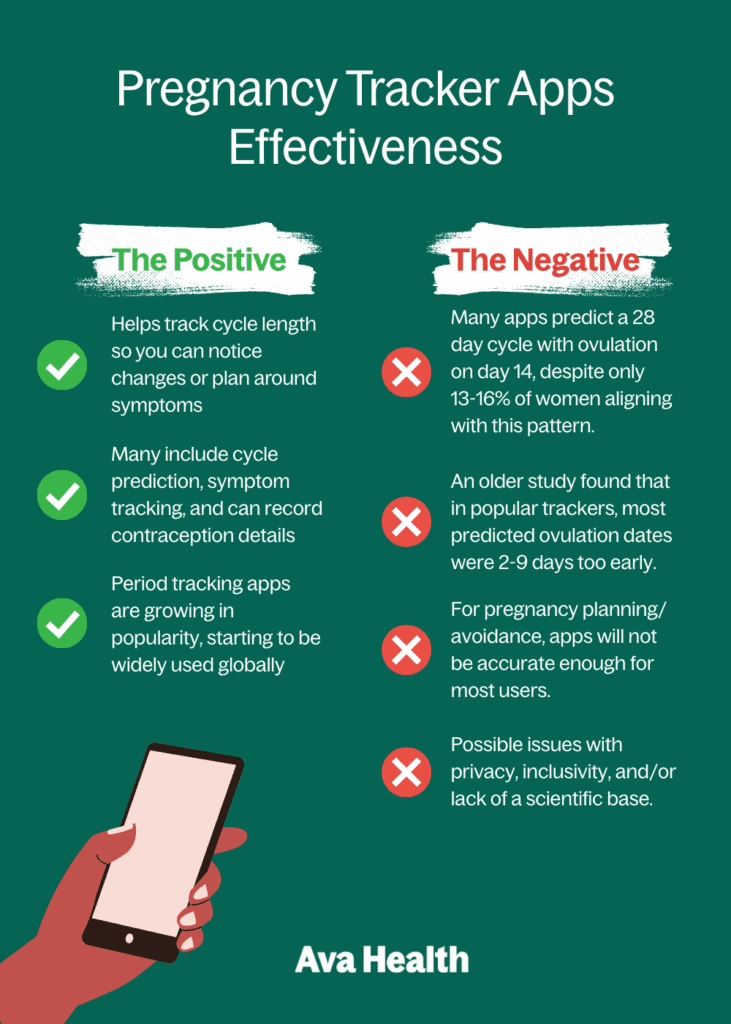
- For example, the Harvard T.H. Chan School of Public Health notes that tracking your cycle via an app may help you understand your average cycle length, recognize when something is off (e.g., heavy or irregular bleeding), and plan around symptoms.
- A recent evaluation of menstrual health apps found that many apps include cycle-prediction and symptom tracking functions, and allow users to input diverse cycle lengths and contraceptive types.
- Millions of users globally are downloading and using period tracking/fertility apps. A study from University of Oxford found large-scale global trends and use of menstrual tracking apps, especially in areas with unmet need for reproductive health services.
But — there are important limitations and caveats.
- Many apps assume a “textbook” 28-day cycle with ovulation on day 14, even though research shows only about 13–16% of women have a 28-day cycle with ovulation on day 14.
- One older study found that in 10 popular apps, only 8% of ovulation predictions for varied cycle profiles were exactly correct; 67% of predictions were 2–9 days early for women with non-standard cycle lengths.
- For fertility or pregnancy planning (or avoidance), this means the predictions may be unreliable unless you’re very regular and the app uses robust data beyond just calendar days.
- Privacy and evidence-base are often lacking. For example, many apps do not cite medical literature, may share data with third parties, may not accommodate less common cycle lengths or diverse gender/sexuality users.
So do they “really work”?
- It depends on what you mean by “work” and what you expect them to do.
- If “working” means helping you log your period bleeding dates and symptoms, then yes—most apps are fine for this.
- If “working” means reliably predicting ovulation, fertile windows, or serving as a standalone contraception method — then the answer is: no, they cannot be trusted as the only method, particularly if your cycle is irregular, you have underlying health issues, or you rely on them for avoiding pregnancy.
- If “working” means providing trustworthy health-education and symptom tracking that helps you notice when something’s different or needs a medical check-in — yes, these tools can contribute, but you still need to interpret results carefully and consult a healthcare provider when needed.
A Moment to Breathe
Your body is created wisely. Your monthly cycle is one of many ways your body talks to you — about your health and your rhythms.. Using a period tracker app can be an act of self-care: noticing how you feel, spotting patterns, giving yourself grace when things shift.
However, your body is not a machine to be predicted with precision every time. Some cycles are short, some long; some months bring irregularity; some bring surprises. That’s not a failure — it’s normal. Having tools is good; depending solely on them isn’t wise.
You should seek information that supports your body’s rhythms, not information that assumes one-size-fits-all.
Reflection
Take a moment: what do you want out of a period tracker app?
- Do you want to simply note when your period comes so you aren’t caught off guard?
- Are you hoping to better understand your symptoms (mood, cramps, fatigue) so you can plan rest or self-care accordingly?
- Are you trying to track fertility or avoid pregnancy using the app alone?
- How regular is your cycle? Do you have conditions (e.g., PCOS, thyroid issues) that make predictions harder?
When you answer these honestly, you’ll better know whether an app can serve you — or whether you’ll need to pair it with professional care, or other methods.
You have the ability to choose, and reading this blog means you’re choosing to stay informed, to use tools wisely and with awareness. That choice honors your values and your body’s rhythm.
Support & Next Steps
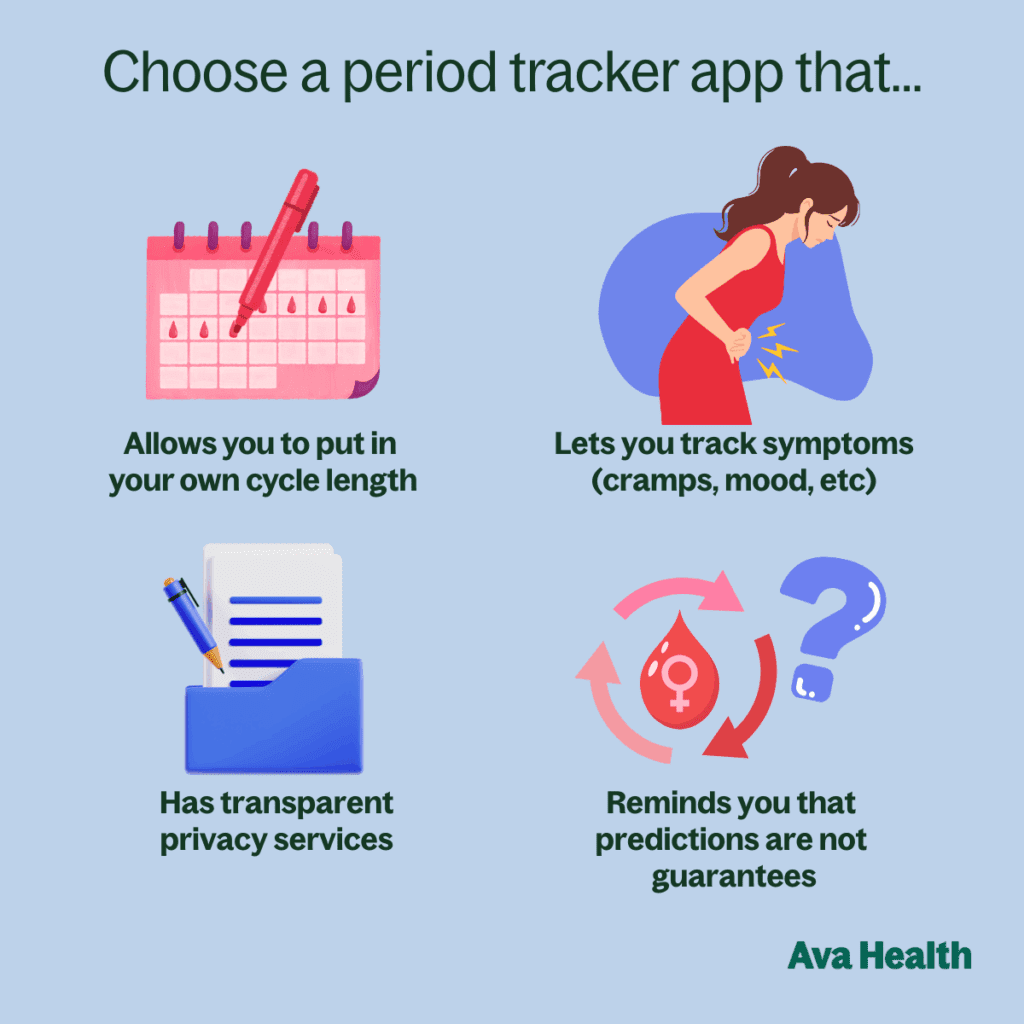
If you decide to use a period tracker app, choose one that:
- Allows you to input your own cycle length and adjust if your cycle is longer/shorter than 28 days.
- Lets you track symptoms (mood, cramps, sleep) beyond just dates of bleeding.
- Has transparent privacy practices — you might read the app’s privacy policy (yes, it’s a bit tedious) or choose apps known to be better on privacy.
- Reminds you that the predictions are approximations, not guarantees.
- If you rely on a tracker for fertility or avoiding pregnancy, please use it in conjunction with professional guidance. It’s a helpful tool but not a replacement for healthcare advice.
- If you notice unusual patterns (e.g., cycles consistently >35 days, very heavy bleeding, persistent pain), you might want to consult a provider. The app’s data can help you describe what you’ve been noticing — but it doesn’t diagnose.
- Feel free to pause and reflect: How am I feeling about this app? Is it helping me feel more connected to my body, or is it creating anxiety or pressure? It’s okay to change your usage or take a break.
- If you’d like further reading, check out our related articles from such as “Can I Only Get Pregnant During Ovulation? A Deep Dive Into Fertility and Timing” and “Is Birth Control 100% Effective? What You Need to Know” to support your broader understanding of reproductive health.
Final Thoughts
You’re doing a good thing by asking: “Do period tracker apps really work?” Your question means you’re ready to engage thoughtfully with the technology, rather than just accepting whatever a notification tells you. You deserve tools that enhance your awareness — not confuse or mislead you.
Have more questions? Talk to our online nurse now or schedule an appointment today if you think you might be pregnant.
Share this Blog
Disclaimer: The content on this site is for informational purposes only and does not constitute medical advice. Ava Health does not refer for or perform abortions. All medical information is accurate at the time of publishing.
Other Articles You Might Be Interested In
Early Pregnancy Symptoms: A Comprehensive Guide to Recognizing the First Signs
Ovarian Cysts: What Do They Mean? Understanding Your Body With Clarity