
OB-GYN vs. Midwife: Key Differences, Care Options & How to Choose
- Medically Reviewed
- Last Updated
It can be confusing trying to figure out what kind of pregnancy or reproductive care you need. surprisingly confusing. People throw around terms like “OB-GYN,” “midwife,” “CNM,” “birth center,” and “high-risk,” and it’s not always clear what any of it means for you and your pregnancy.
This guide will walk you through the differences, including:
- what an OB-GYN does during pregnancy and beyond
- the different types of midwives (and why that matters)
- midwife vs OB-GYN for low-risk pregnancy
- when it’s safer to see an OB-GYN (or a specialist)
- how team-based care works in real life
Table of Contents
What is an OB-GYN?
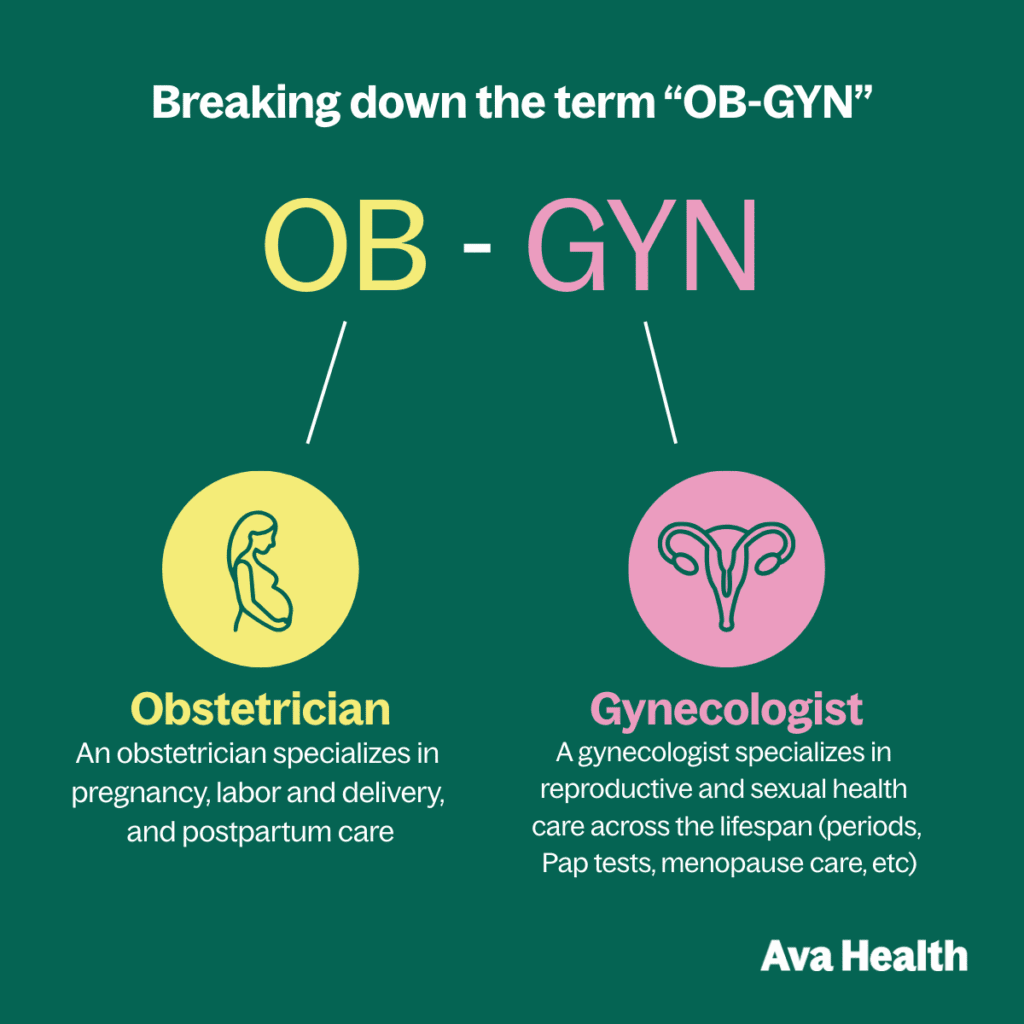
OB-GYN stands for obstetrician–gynecologist. An OB-GYN is a medical doctor who specializes in two connected areas of care:
- Obstetrics: pregnancy, labor and delivery, and postpartum care
- Gynecology: reproductive and sexual health care across the lifespan (periods, pelvic pain, fibroids, infections, Pap tests, contraception, menopause care, and more)
Because OB-GYNs are physicians, they can provide medical and surgical care—including performing C-sections and other procedures when needed.
OB-GYN training (and why it matters)
OB-GYNs complete medical school and then a four-year OB-GYN residency with extensive training across pregnancy care, labor and delivery, surgery, ultrasound, and more.
That level of training is especially important if you:
- have a high-risk pregnancy
- need a planned or urgent C-section
- have pregnancy complications (like severe high blood pressure, significant bleeding, placenta concerns, or certain medical conditions)
ACOG (the American College of Obstetricians and Gynecologists) also notes that high-risk pregnancies sometimes require care from maternal-fetal medicine specialists (MFM), who are OB-GYNs with additional training in complex pregnancies.
What is a midwife?
A midwife is a trained health professional who focuses on pregnancy, birth, postpartum, and often broader reproductive health care—especially for women with low-risk pregnancies.
Many women choose midwifery care because it often emphasizes:
- longer visits and education
- shared decision-making
- a supportive, low-intervention approach when appropriate
- continuous labor support (depending on the setting and practice)
Midwives can practice in different settings—hospitals, birth centers, and sometimes homes—depending on the type of midwife and local regulations.
Not all midwives have the same training
This part is important and often overlooked: “midwife” isn’t one single credential. Training and legal scope can vary a lot.
These are the most common categories you’ll see here in the U.S.:
Certified Nurse-Midwife (CNM) and Certified Midwife (CM)
Both CNMs and CMs are credentialed and certified through national standards. They must meet professional competencies and maintain certification through continuing education and recertification requirements. The difference is that CNMs are nurses first (usually on labor and delivery) and then they go to 2-3 years of specialized training. They always have a physician back up.
In many states and settings, CNMs especially may provide:
- prenatal and postpartum care
- labor and birth care for low-risk pregnancies
- gynecologic care (Pap tests, contraception counseling, STI screening, etc.)
Certified Midwife (CM) and Direct-Entry Midwives (state-regulated)
CM is a credential used by some community-based midwives. In Oregon, direct-entry midwifery is licensed through the state, with specific application and clinical experience requirements. However, they don’t have nearly as much training as CNMs.
Because requirements and practice authority can vary by state, it’s wise to confirm:
- what credential your midwife holds
- where they can legally practice
- what happens if you need transfer to hospital care
(If you’re in Oregon, the Oregon Health Authority provides licensing information for what it takes to become a direct-entry midwife.)
Midwife vs OB-GYN: the clearest differences
1. Medical training and ability to do surgery
- OB-GYN: physician + surgeon; can perform C-sections and other surgeries
- Midwife (CNM/CM): advanced midwifery training; focuses on low-risk pregnancy and supportive care; does not perform C-sections (but may assist or collaborate in hospital settings depending on if they are a CNM or not, and depending on their abilities)
2. Best fit: low-risk vs high-risk pregnancy
- Midwives often specialize in low-risk pregnancy care and normal physiologic birth.
- OB-GYNs are essential for high-risk pregnancy care and complications, and they provide a full range of medical and surgical options.
3. Appointment style and model of care
This varies by practice, but many people notice:
- Midwifery care may include longer visits, education, and a strong focus on wellness and birth preparation.
- OB-GYN care may feel more medicalized (especially in busy practices), with more frequent monitoring only if risk factors are present.
Neither approach is “better.” The goal is to find care that matches your health needs and helps you feel safe, respected, and well-informed about your pregnancy journey.
4. Birth settings and pain management options
Depending on your provider and location, you may see options like:
- Hospital labor and delivery (this could be for an OB-GYN or midwife)
- Hospital-based birth center (often midwives, with OB-GYN backup)
- Freestanding birth center (varies by state and staffing)
- Home birth (typically community-based midwives, where legal and appropriate)
Pain management also varies by setting. In hospitals, midwives and OB-GYNs may both support medical pain relief options (like epidurals), as well as non-medicated comfort measures.
What does an OB-GYN do during pregnancy?
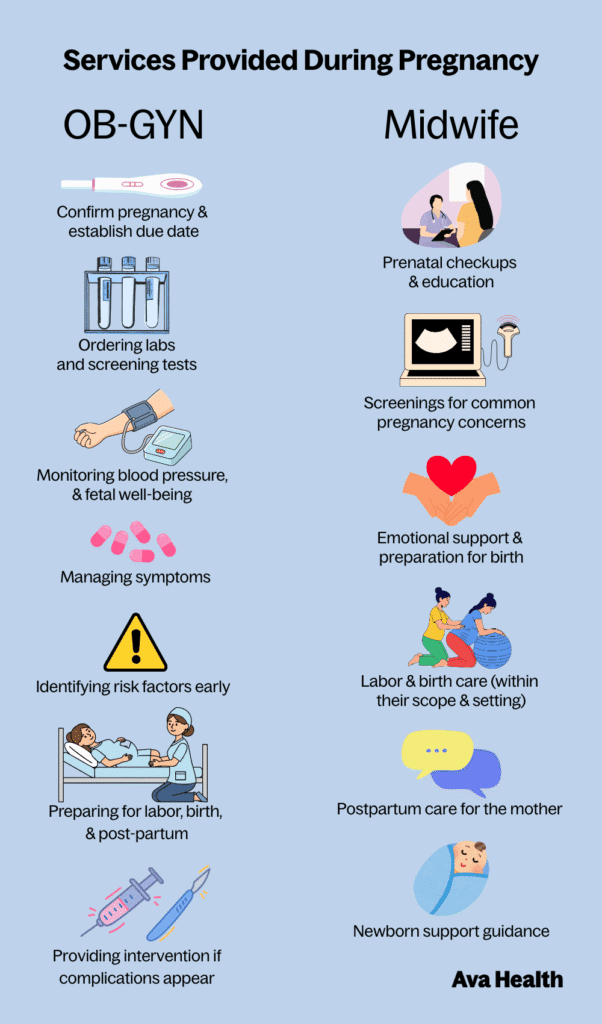
In general, OB-GYN prenatal care may include:
- confirming pregnancy and establishing due date
- ordering labs and screening tests
- monitoring blood pressure, growth, and fetal well-being
- managing symptoms like nausea, anemia, or pelvic pain
- identifying risk factors early (and coordinating specialist care if needed)
- planning for labor, birth, and postpartum recovery
- providing medical interventions if complications appear
And if a pregnancy becomes high-risk, OB-GYNs can coordinate with maternal-fetal medicine (MFM) specialists, like we mentioned earlier, for more advanced monitoring and decision-making.
What does a midwife do during pregnancy and postpartum?
Midwives typically provide:
- prenatal checkups and education
- screening for common pregnancy concerns
- emotional support and preparation for birth
- labor and birth care (within their scope and setting)
- postpartum care for the woman and newborn support guidance
Many people are looking for extended support after birth—help with recovery, feeding questions, and adjusting to big changes. The specifics depend on the midwife’s credential and practice model.
Can a midwife deliver in a hospital?
Often, yes—especially certified nurse-midwives (CNMs), who commonly practice in hospitals and collaborate with OB-GYN teams.
In many hospital systems, midwives and OB-GYNs work side by side:
- midwives manage low-risk labor and births
- OB-GYNs step in for complications, operative deliveries, or C-sections
- both may share prenatal and postpartum care depending on the clinic
When to see an OB-GYN vs a midwife
You may want an OB-GYN if:
- you have a history of pregnancy complications
- you’re pregnant with multiples (twins/triplets)
- you have certain medical conditions (like significant heart disease, uncontrolled diabetes, severe hypertension, clotting disorders, etc.)
- you’re told your pregnancy is high-risk
- you want access to surgical options within the same provider relationship
You may be a good fit for midwifery care if:
- your pregnancy is currently considered low-risk
- you want a relationship-centered approach and lots of education
- you’re interested in a lower-intervention birth plan (while still valuing safety and flexibility)
- you want a provider who may spend more time discussing your preferences and comfort measures
Many women use both (yes, really)
It’s common to have a midwife and OB-GYN on the same care team, particularly in hospitals and integrated clinics. In these models, you may see a midwife for much of your care, with an OB-GYN available if higher-level medical support is needed.
What to consider when choosing:
Here are some questions that can make your decision clearer:
- Where do you want to give birth? Hospital, birth center, home?
- What is your risk level right now? Any medical conditions, prior complications, or current concerns?
- How does this provider (OB-GYN or midwife) handle transfers or emergencies? (Especially important when considering giving birth in other settings than a hospital.)
- What pain-management options matter to you?
- Do you feel heard and respected in appointments?
- What does postpartum support look like?
- Is your insurance accepted, or do you need low-cost options?
If cost is a concern, use this guide to help you explore free and low-cost pregnancy services and prenatal care options: Pregnancy Services Without Insurance: Free and Low-Cost Care
A note about ultrasounds and pregnancy confirmation
Sometimes the first step isn’t choosing an OB-GYN or midwife yet—it’s confirming what’s going on in your early pregnancy and knowing how far along you are.
If you think you might be pregnant and want some next steps:
If you’re trying to understand how pregnancy ultrasounds work:
And if you’re looking for local support:
(These can be especially helpful if you’re early in pregnancy and just want answers in a calm, nonjudgmental space.)
Common myths about OB-GYNs and midwives
Myth: “Midwives are only for home birth.”
Reality: Many midwives (especially CNMs) work in hospitals and support a wide range of birth preferences.
Myth: “OB-GYNs always push interventions.”
Reality: OB-GYNs are trained to manage complications and use interventions when medically needed, but many also support low-intervention births—especially when pregnancy is low-risk.
Myth: “You have to choose one forever.”
Reality: Your care can change over time. Some pregnancies start low-risk and become more complex. Some start complex and stabilize. Choosing care is not a one-time decision—it’s a process.
Safety, collaboration, and what “high-risk” really means
Hearing “high-risk” can feel scary, but it doesn’t automatically mean something will go wrong. It usually means you and/or the baby may need extra monitoring or specialized expertise to support the healthiest outcome possible.
This is where collaborative care can shine:
- midwives supporting comfort, education, and continuous care
- OB-GYNs managing medical complexity
- Specialists, like MLMs, supporting advanced monitoring when needed
That kind of teamwork can protect both safety and dignity—two things you deserve in every healthcare experience.
OB-GYN vs midwife: TL;DR
Choose an OB-GYN as part of your team if you want/need:
- surgical capability (including C-section)
- high-risk pregnancy management
- complex medical care during pregnancy or beyond
Choose a midwife as part of your team if you want/need:
- low-risk pregnancy care with a relationship-centered model
- strong education and support through pregnancy and postpartum
- a low-intervention approach when medically appropriate
Choose a team that includes both if you want:
- the best of both worlds: supportive, continuous care + immediate backup for complications
FAQs
What is the main difference between a midwife and an OB-GYN?
An OB-GYN is a physician and surgeon trained to provide medical and surgical care, including C-sections. A midwife focuses on pregnancy and birth support (often for low-risk pregnancies) and may practice in hospitals, birth centers, or community settings depending on credential and local laws.
Is a midwife safe for a low-risk pregnancy?
For many women with low-risk pregnancies, midwifery care can be a safe option—especially when midwives practice within their scope and have clear collaboration or transfer pathways if complications arise.
Can I have a midwife in a hospital?
Yes, many certified nurse-midwives practice in hospitals and work alongside OB-GYN teams.
When should I switch from a midwife to an OB-GYN?
If you develop complications that increase risk—like significant bleeding, preeclampsia concerns, placenta problems, or other medical issues—your care may shift to an OB-GYN or a specialist for safety. Your midwife should be able to give you more information about when it would be appropriate to include an OB-GYN on your team, or switch over to an OB-GYN fully.
What if I’m not sure what kind of care I need yet?
That’s normal. A good first step is pregnancy confirmation (testing and, when appropriate, ultrasound) so you can make decisions based on accurate pregnancy dates and information.
Next steps (especially if you’re early in pregnancy)
If you’re in that in-between space—wondering what’s happening in your body, what kind of provider you need, or what your options are—support can make a real difference.
Ava Health offers clear, confidential information and services that can help you get grounded:
You deserve care that helps you feel safe, informed, and supported—without pressure.
Sources
American College of Nurse-Midwives. About Midwives. ACNM, https://midwife.org/about-midwifery/. Accessed 11 Feb. 2026.
National Academies of Sciences, Engineering, and Medicine. Assessing Health Outcomes by Birth Settings. National Academies Press, 2020, https://www.nationalacademies.org/projects/DBASSE-BCYF-18-01. Accessed 11 Feb. 2026.
Sandall, Jane, et al. “Midwife-Led Continuity Models versus Other Models of Care for Childbearing Women.” Cochrane Database of Systematic Reviews, no. 4, 2016, doi:10.1002/14651858.CD004667.pub5.
Oregon Health Authority. Board of Direct Entry Midwifery. State of Oregon, www.oregon.gov/oha/ph/hlo/pages/board-direct-entry-midwifery.aspx. Accessed 11 Feb. 2026.
Share this Blog
Disclaimer: The content on this site is for informational purposes only and does not constitute medical advice. Ava Health does not refer for or perform abortions. All medical information is accurate at the time of publishing.
Medically Reviewed By:

Ava Health
Other Articles You Might Be Interested In