

If you’re exploring birth control options, you’re not alone. Many women want to understand how different methods work, what’s effective, and which choice fits their health, values, and lifestyle. Among the wide range of contraceptives available today, the birth control patch—also called the skin patch—is one option you may have heard about.
In this guide, we’ll break down what the patch is, how it works, possible side effects, and other methods of birth control. Whether you’re trying to prevent pregnancy, regulate your menstrual cycle, or simply understand your body better, knowing your options is an important step toward informed decision-making.
Understanding the Birth Control Patch
The birth control patch is a small, square adhesive patch (about two inches wide) that sticks to your skin and releases hormones to prevent pregnancy.
Most commonly, it contains estrogen and progestin—the same hormones found in many birth control pills. These hormones work together to:
- Stop ovulation (prevent the release of an egg from the ovary)
- Thicken cervical mucus, making it harder for sperm to reach an egg
- Thin the uterine lining, reducing the chance of implantation
The patch delivers hormones through the skin and into your bloodstream continuously over a week.
How the Skin Patch Is Used
Typically, the patch follows a four-week cycle:
- Apply a new patch once a week for three weeks (21 days total).
- No patch during the fourth week (your menstrual period usually occurs during this week).
- Start a new patch after the patch-free week.
You can place the patch on the buttocks, abdomen, upper outer arm, or upper torso (but not on your breasts). It should stick firmly and remain in place, even while showering or swimming.

Effectiveness of the Patch
When used perfectly, the patch is about 99% effective at preventing pregnancy. However, with typical use—which includes forgetting to replace the patch on time or it accidentally falling off—the effectiveness drops closer to 91%.
Some factors that may reduce the patch’s effectiveness include:
- Not changing it weekly as directed
- Using certain medications that affect hormones
- Weighing over 198 pounds (90 kg), as the patch may be less effective in higher body weights
If the patch falls off for more than 24 hours, or if you forget to change it on time, a backup method such as condoms is recommended.
Common Side Effects of the Patch
Like other hormonal birth control methods, the patch can cause side effects, especially in the first few months of use. Common side effects include:
- Nausea or upset stomach
- Breast tenderness
- Headaches
- Skin irritation where the patch is applied
- Spotting or irregular bleeding between periods
Less common but more serious risks may include:
- Increased risk of blood clots
- Stroke or heart attack (especially in women who smoke and are over 35)
- Elevated blood pressure
Because of these risks, the patch isn’t recommended for everyone. It’s important to talk with a healthcare provider about your medical history and any risk factors before starting hormonal birth control.
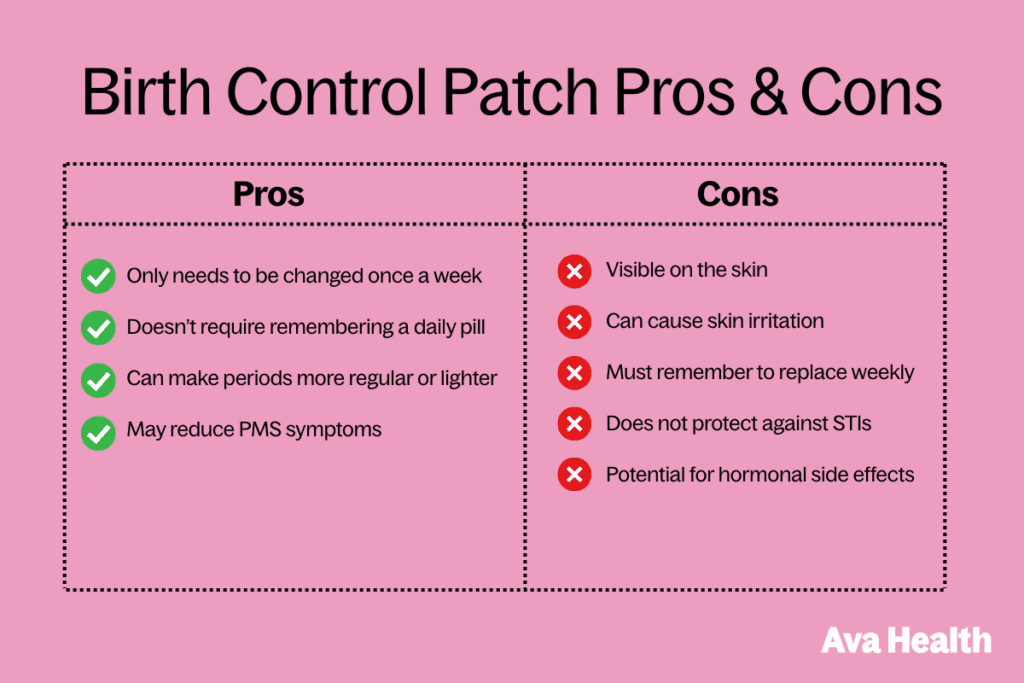
Pros and Cons of the Birth Control Patch
Pros:
- Only needs to be changed once a week
- Doesn’t require remembering a daily pill
- Can make periods more regular or lighter
- May reduce PMS symptoms
Cons:
- Visible on the skin
- Can cause skin irritation
- Must remember to replace weekly
- Does not protect against sexually transmitted infections (STIs)
- Potential for hormonal side effects
For those who prefer not to take daily pills or get injections, the patch can be a convenient option. But for others, hormone sensitivity or skin irritation might make it less appealing.
How Other Birth Control Methods Compare to the Birth Control Patch
The birth control patch is a hormonal method that releases estrogen and progestin through your skin. You replace it weekly for three weeks, followed by one patch-free week. It prevents pregnancy by stopping ovulation and thickening cervical mucus.
If you’re considering the patch, it can help to see how other options compare in terms of effectiveness, ease of use, side effects, and long-term commitment.
1. The Birth Control Pill vs. The Patch
Like the patch, the pill usually contains estrogen and progestin and works in the same way — by preventing ovulation and thickening cervical mucus.
Key Difference:
The pill must be taken every day at the same time, while the patch is changed once a week.
Effectiveness
- Perfect use: 99% (both pill and patch)
Typical use: Around 91% (both)
Why someone might choose the pill over the patch:
- Prefer a daily routine
Want to avoid wearing something visible on the skin
Why someone might choose the patch instead:
Easier to remember once-weekly changes rather than daily dosing
Similar side effects:
Nausea, breast tenderness, headaches, mood changes.
2. The Vaginal Ring vs. The Patch
The vaginal ring (NuvaRing or Annovera) also releases estrogen and progestin, similar to the patch.
Key Difference:
The ring is inserted into the vagina and left in place for three weeks, while the patch is worn on the skin and replaced weekly.
Effectiveness
- Perfect use: 99%
Typical use: 91%
Why someone might choose the ring over the patch:
- Only needs attention once per month
No visible external method
Why someone might choose the patch instead:
- Prefer not to insert a device vaginally
More comfortable with a visible reminder
The ring may cause vaginal irritation or discharge, while the patch may cause mild skin irritation.
3. The Birth Control Shot vs. The Patch
The Depo-Provera shot contains only progestin and is given once every three months.
Key Difference:
The shot requires a clinic visit every 12 weeks. The patch is self-managed and replaced weekly.
Effectiveness
- Shot typical use: ~94%
Patch typical use: ~91%
Why someone might choose the shot:
- No weekly or daily reminders
Fewer routine tasks
Why someone might choose the patch:
- Fertility returns faster after stopping
- Avoid possible weight gain or delayed cycle return
The shot may cause irregular bleeding and can delay fertility return for several months after stopping. The patch typically allows cycles to return more quickly.
4. IUDs vs. The Patch
IUDs are small devices placed in the uterus by a provider. They can be hormonal (like Mirena or Kyleena) or non-hormonal (copper IUD).
Key Difference:
The patch requires weekly attention. IUDs provide long-term protection (3–10 years) with no ongoing maintenance.
Effectiveness
- IUDs: Over 99%
Patch: 91% typical use
Why someone might choose an IUD:
- Highly effective
- “Set it and forget it”
Long-term protection
Why someone might choose the patch:
- No procedure required
- Easier to stop anytime without a provider visit
Short-term or flexible option
IUD insertion can be uncomfortable, and removal requires a provider. If pregnancy occurs with an IUD in place, it is more likely to be ectopic than pregnancies without an IUD. To learn more about IUD’s see What is an IUD?
5. The Birth Control Implant vs. The Patch
The implant (Nexplanon) is a small rod placed under the skin of the upper arm and releases progestin for up to three years.
Key Difference:
The implant is long-term and low maintenance. The patch is short-term and changed weekly.
Effectiveness
- Implant: Over 99%
Patch: 91% typical use
Why someone might choose the implant:
- Very low maintenance
Highly effective
Why someone might choose the patch:
- No minor procedure required
Easier to discontinue quickly
The implant may cause irregular bleeding or weight changes. Placement and removal require a provider.
6. Barrier Methods vs. The Patch
Barrier methods (condoms, diaphragms, cervical caps, spermicides) prevent sperm from reaching the egg.
Key Difference:
The patch is hormonal and works continuously. Barrier methods must be used every time you have sex.
Effectiveness
- Condoms: 85–98% depending on use
- Diaphragm: 88–94%
Patch: 91% typical use
Why someone might choose barrier methods:
- No hormones
- Condoms reduce STI risk
Available over the counter
Why someone might choose the patch:
- No interruption during intimacy
More consistent pregnancy prevention if used correctly
The patch does not protect against STIs — condoms are still recommended for STI prevention.
7. Natural Family Planning vs. The Patch
Fertility awareness methods involve tracking ovulation through temperature, cervical mucus, and cycle timing.
Key Difference:
The patch prevents ovulation automatically. Natural methods require daily tracking and avoiding unprotected sex during fertile days.
Effectiveness
- 76–99% depending on accuracy
Patch: 91% typical use
Why someone might choose fertility awareness:
- No hormones or devices
Increased cycle awareness
Why someone might choose the patch:
- More consistent effectiveness
Less daily monitoring required
Natural methods do not protect against STIs. To learn more about Natural Family Planning, see Natural Family Planning.
8. Permanent Birth Control vs. The Patch
Sterilization (tubal ligation or vasectomy) permanently prevents pregnancy.
Key Difference:
The patch is temporary and reversible. Sterilization is intended to be permanent.
Effectiveness
Over 99%
Why someone might choose sterilization:
- Certain they do not want future pregnancies
No ongoing maintenance
Why someone might choose the patch:
- Wants flexibility
Not ready for a permanent decision
Sterilization requires a surgical procedure and is generally not reversible.
Abstinence: The Only 100% Effective Option
While many birth control methods are highly effective, abstinence—choosing not to have sexual intercourse—is the only method that is 100% effective in preventing pregnancy and STIs.
For some, abstinence is a temporary choice during certain life seasons. For others, it’s a long-term lifestyle decision. It’s also a valid and healthy option for individuals wanting to focus on emotional, relational, or spiritual goals.
At Ava Health, we believe that every person deserves support and accurate information—whether they are sexually active, abstinent, or considering different options for their reproductive health.
How to Choose the Right Birth Control Method
When choosing a birth control method, it’s important to consider:
- Your overall health and medical history
- How often you’re sexually active
- Whether you want to have children in the future
- Comfort with using hormones or devices
- Desire for privacy or convenience
- Risk of sexually transmitted infections
Because not all methods are safe or effective for everyone, it’s best to talk with a trusted healthcare provider before making a decision. They can help you evaluate your options and determine what fits your body and lifestyle best.
See more in-depth information about birth control types at What are the different types of Birth Control?
What to Remember About Hormonal Birth Control
While hormonal methods like the patch, pill, or shot can be effective, they also come with potential side effects and emotional considerations.
Some women experience positive effects, such as reduced cramps or clearer skin. Others report mood changes, depression, or anxiety, particularly when starting or changing methods.
Additionally, these methods do not protect against STIs, so using a condom or abstaining from sex remains important for disease prevention.
If you’re considering hormonal birth control, take time to review all potential effects—both physical and emotional—and speak with a healthcare professional who can help you weigh the pros and cons.
Supporting Your Whole Health at Ava Health
At Ava Health, we’re here to help you understand your body, your fertility, and your options—without judgment or pressure.
Our services include:
- Pregnancy testing and confirmation
- Ultrasound services to determine pregnancy viability and gestational age
- Education on pregnancy options, including parenting, adoption, and abortion information
- Informative consultations to help you make informed decisions
We do not perform or refer for abortions, but we provide medically accurate information and compassionate care to ensure you have the facts you need to make confident, informed choices about your health.
Final Thoughts
The birth control patch is one of several options available today for preventing pregnancy, but it’s not right for everyone. Understanding how it works—and how it compares to other methods—can empower you to make the best choice for your health, values, and lifestyle.
Remember: no matter where you are in your journey, you deserve clear information, compassionate support, and care that respects your values.
Though Ava Health does not refer or provide birth control, we are happy to answer questions if you have them. Contact us today to schedule an appointment if you think you might be pregnant, want to get tested for STI’s, or just have questions about your sexual health.
Note: This blog post is for informational purposes only and does not constitute medical advice. Ava Health does not refer for or perform abortions. All medical information is accurate at the time of publishing this blog.
Sources
Centers for Disease Control and Prevention. Contraception. CDC, 2024, https://www.cdc.gov/contraception/?CDC_AAref_Val=https://www.cdc.gov/reproductivehealth/contraception/index.htm.
Mayo Clinic. Birth Control Patch. Mayo Clinic, 2023, https://www.mayoclinic.org/tests-procedures/birth-control-patch/about/pac-20384553.
American College of Obstetricians and Gynecologists. Combined Hormonal Birth Control: Pill, Patch, and Ring. ACOG, 2024, https://www.acog.org/womens-health/faqs/combined-hormonal-birth-control-pill-patch-ring.
MedlinePlus. Birth Control Patch. National Library of Medicine, 2023, https://medlineplus.gov/ency/patientinstructions/000656.htm.
Cleveland Clinic. Birth Control Options. Cleveland Clinic, 2023, https://my.clevelandclinic.org/health/articles/11427-birth-control-options.
American Pregnancy Association. Birth Control Methods. American Pregnancy Association, 2024, https://americanpregnancy.org/unplanned-pregnancy/birth-control/.
U.S. Department of Health & Human Services, Office on Women’s Health. Birth Control Methods. 2024, https://www.womenshealth.gov/a-z-topics/birth-control-methods.
Abortion Pill Reversal. Hormonal Birth Control Information. 2024, https://www.abortionpillreversal.com/.
