
When it comes to birth control, there are more options than ever before. From hormonal methods to devices and natural approaches, choosing what’s best for you can feel overwhelming. But if your goal is to completely prevent pregnancy, there’s one fact that remains true: abstinence is the only method that’s 100% effective.
At Ava Health, we believe that understanding your body and your options empowers you to make informed decisions about your health, relationships, and future. Let’s explore what makes abstinence unique—and take a closer look at other forms of birth control, their effectiveness, and what you should consider before choosing one.
What Does “Birth Control” Really Mean?
Birth control, sometimes called contraception, includes any method or behavior used to prevent pregnancy. While many options reduce the risk, none are completely foolproof—except abstinence.
Every other method—whether hormonal, physical, or behavioral—comes with a typical use failure rate. That means even when used correctly most of the time, pregnancies can still happen.
Abstinence: The Only 100% Effective Method
Abstinence means choosing not to have vaginal sex. When practiced consistently, it is the only method that completely prevents pregnancy.
Benefits of Abstinence
- 100% effective at preventing pregnancy
- No medical side effects
- Protects emotional and physical health
- Prevents STIs when all forms of sexual activity that exchange bodily fluids are avoided
- Free and always available
Abstinence is also the only risk free choice. It can help avoid emotional stress and potential health risks that sometimes come with sexual activity.
At Ava Health, we provide a safe, judgment-free space to talk about your choices. Whether you’re sexually active or not, we’re here to help you understand your options.
How Other Birth Control Methods Compare
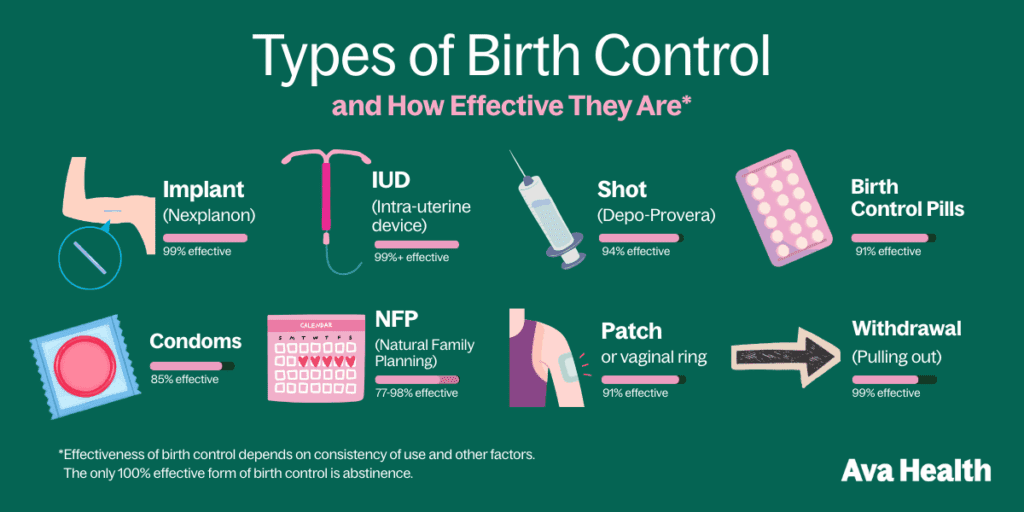
While abstinence is the only 100% effective method, here’s how other common forms of birth control measure up:
Implant (Nexplanon)
A small rod inserted under the skin that releases hormones to prevent ovulation.
- Effectiveness: About 99% with typical use
- Lasts: Up to 3 years
- Considerations: May cause irregular bleeding, weight changes, or mood swings, may not protect against STI’s
IUD (Intrauterine Device)
A small, T-shaped device placed in the uterus by a healthcare provider. Comes in hormonal (Mirena, Kyleena) or non-hormonal (copper) versions.
- Effectiveness: Over 99%
- Lasts: 3–10 years depending on the type
- Considerations: May cause cramping or changes in bleeding patterns, may not protect against STI’s. In addition, a pregnancy with an IUD present is more often ectopic than a pregnancy with no IUD.
For more in-depth information about IUD’s see What is an IUD?
Birth Control Shot (Depo-Provera)
An injection that prevents ovulation for about three months.
- Effectiveness: Around 94% with typical use
- Considerations: Requires consistent appointments; may affect bone density over time, may not protect against STI’s
Birth Control Pill
A daily hormonal pill that prevents ovulation.
- Effectiveness: Around 91% with typical use
- Considerations: Must be taken daily at the same time; can affect mood and cycle regularity, may not protect against STI’s
Patch or Vaginal Ring
Hormonal methods absorbed through the skin or vaginal tissue.
- Effectiveness: Around 91% with typical use
- Considerations: Requires monthly maintenance; may increase risk of blood clots for some users, may not protect against STI’s
For more information on the birth control patch, check out What is the skin patch for birth control?
Condoms
A barrier method that blocks sperm from reaching the egg.
- Effectiveness: Around 85% with typical use
- Considerations: Must be used correctly every time; reduces the risk of STI transmission with proper use
Natural Family Planning (Fertility Awareness)
Tracking ovulation signs to avoid intercourse during fertile days.
- Effectiveness: 77–98% depending on consistency and accuracy
- Considerations: Requires daily tracking and self-discipline; may not protect against STIs
For more in-depth information on Natural Family Planning, see Natural Family Planning
Withdrawal (“Pulling Out”)
When the penis is removed from the vagina before ejaculation.
- Effectiveness: About 78% with typical use
- Considerations: High risk of failure; may not prevent STIs
For more information on birth control methods, see What are the different types of Birth Control?
Why No Method Other Than Abstinence Is 100% Effective
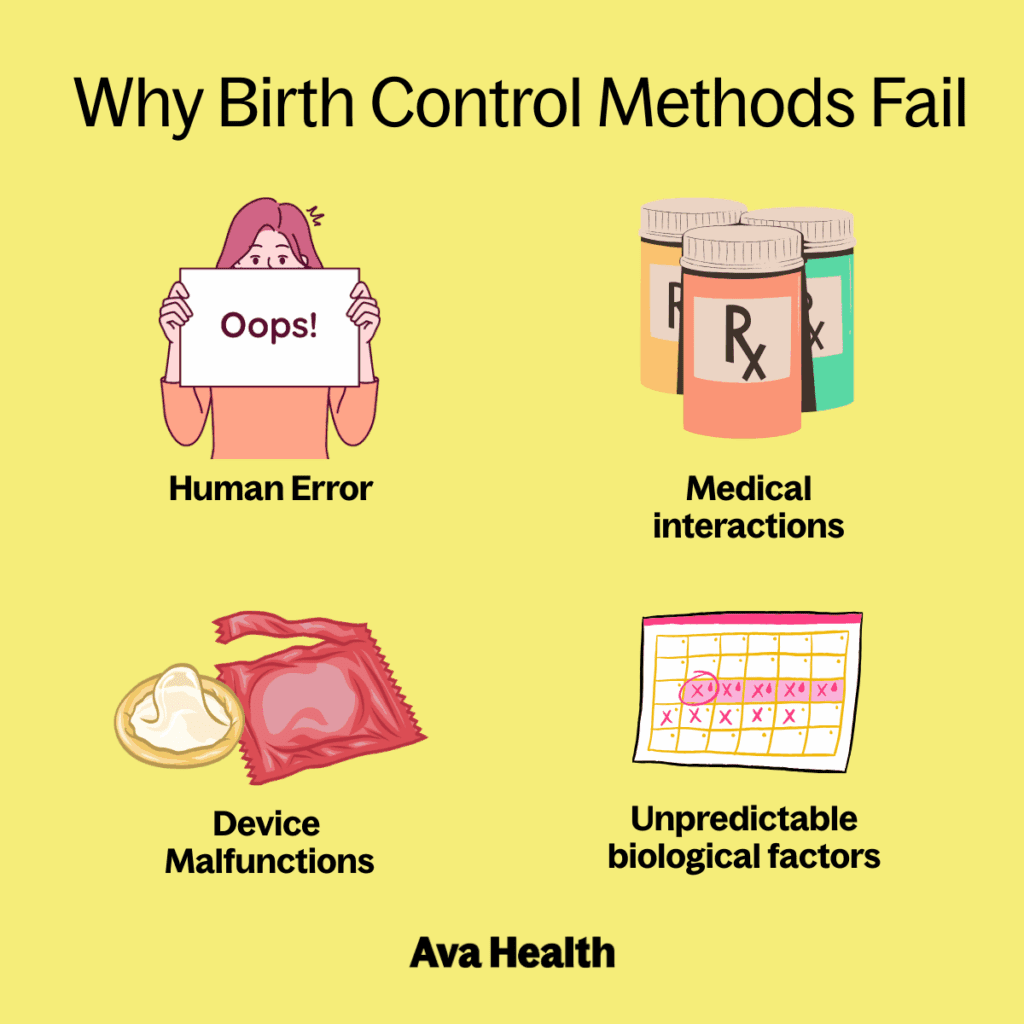
Even with perfect use, hormonal or barrier methods can fail due to:
- Human error (missed pills, incorrect use, expired products)
- Medical interactions
- Device malfunctions
- Unpredictable biological factors
That’s why, despite impressive statistics, no form of contraception other than abstinence can offer complete assurance against pregnancy and sexually transmitted infections.
Emotional and Physical Considerations
Birth control isn’t only about avoiding pregnancy—it’s also about emotional readiness, relationship boundaries, and personal values.
Some people choose abstinence to protect their mental and emotional health, while others practice it for spiritual, relational, or medical reasons. Whatever your motivation, knowing why you’re making that decision helps you stand by it confidently.
If you’re unsure about what’s right for you, that’s okay. Our compassionate team at Ava Health can help you understand your choices in a confidential, supportive setting.
What About Emergency Contraception?
Emergency contraception (sometimes called the “morning-after pill”) is used after unprotected sex or a birth control failure. While it can reduce the risk of pregnancy, it’s not a regular contraception method and not 100% effective.
It also does not protect against sexually transmitted infections and may cause short-term side effects like nausea or irregular bleeding.
If you think you might be pregnant after unprotected sex, Ava Health offers free and confidential pregnancy testing.
Making an Informed Choice
Every person’s situation is different. Your age, health, relationship status, and goals all play a role in determining what’s best for you. That’s why it’s important to speak with a qualified professional before starting or stopping any birth control method.
At Ava Health, we don’t profit from your decision. We simply want to equip you with medically accurate information so you can make a confident, informed choice about your body and future.
Key Takeaways
- Abstinence is the only 100% effective method to prevent pregnancy and STIs.
- Other birth control options can greatly reduce risk but aren’t foolproof.
- Understanding your health and values helps guide the best choice for you.
- Ava Health offers free, confidential consultations to discuss your options—without pressure or judgment.
Considering Your Next Step?
If you’re thinking about birth control, worried about pregnancy, or simply want to understand your body better, we’re here to help.
Ava Health provides free pregnancy testing, options education, and compassionate support—no insurance required.
Visit avahealthpdx.org or call to schedule a confidential appointment today.
Note: This blog post is for informational purposes only and does not constitute medical advice. Ava Health does not refer for or perform abortions. All medical information is accurate at the time of publishing this blog.
Sources
American College of Obstetricians and Gynecologists. “Birth Control: Frequently Asked Questions for Teens.” ACOG, https://www.acog.org/womens-health/faqs/birth-control.
Centers for Disease Control and Prevention. “Contraception and Birth Control Methods.” CDC, 06 Aug. 2024, https://www.cdc.gov/contraception/about/index.html.
Guttmacher Institute. “Contraceptive Use in the United States.” Guttmacher Institute, https://www.guttmacher.org/fact-sheet/contraceptive-use-united-states.
Johns Hopkins Medicine. “Conception/Birth Control.” Johns Hopkins Medicine, https://www.hopkinsmedicine.org/health/wellness-and-prevention/contraception-birth-control.
Mayo Clinic. “Birth Control Options: Things to Consider.” Mayo Clinic, https://www.mayoclinic.org/healthy-lifestyle/birth-control/in-depth/birth-control-options/art-20045571.
Mayo Clinic. “Combination Birth Control Pills.” Mayo Clinic, https://www.mayoclinic.org/tests-procedures/combination-birth-control-pills/doctors-departments/pdc-20385283.
Office on Women’s Health, U.S. Department of Health & Human Services. “Birth Control Methods.” womenshealth.gov, https://www.womenshealth.gov/a-z-topics/birth-control-methods.
World Health Organization. “Family Planning/Contraception Methods.” WHO, https://www.who.int/news-room/fact-sheets/detail/family-planning-contraception.