- Ava Health
It’s completely normal to feel unsure when you notice unexpected bleeding. Many women find themselves wondering the same thing: Is this my period, or could something else be happening?
If you’re asking these questions, you’re not overthinking. You’re simply paying attention to your body — and that’s a good thing.
Implantation bleeding and a menstrual period can look similar at first, especially if pregnancy isn’t something you were expecting. With a little information, it becomes easier to understand what your body may be signaling and what steps might bring clarity.
Table of Contents
What is implantation bleeding?
Implantation bleeding is light spotting that can happen early in pregnancy, when a pregnancy attaches to the lining of the uterus.
This usually occurs:
- About 6–12 days after ovulation
- Around the time a period might normally begin
- Often before a pregnancy test would reliably show a positive result
Not all women experience implantation bleeding. Many people don’t notice any spotting at all in early pregnancy, and that can be perfectly normal.
What is a period?
A menstrual period happens when pregnancy has not occurred. Hormone levels shift, and the uterus sheds the lining it prepared during the cycle.
Periods typically:
- Follow a familiar rhythm (typical symptoms, feelings, experiences) for your body (even if you’re off by a couple days)
- Last several days
- Involve a heavier flow than implantation bleeding
Because timing can overlap, it’s understandable that the two are often confused.
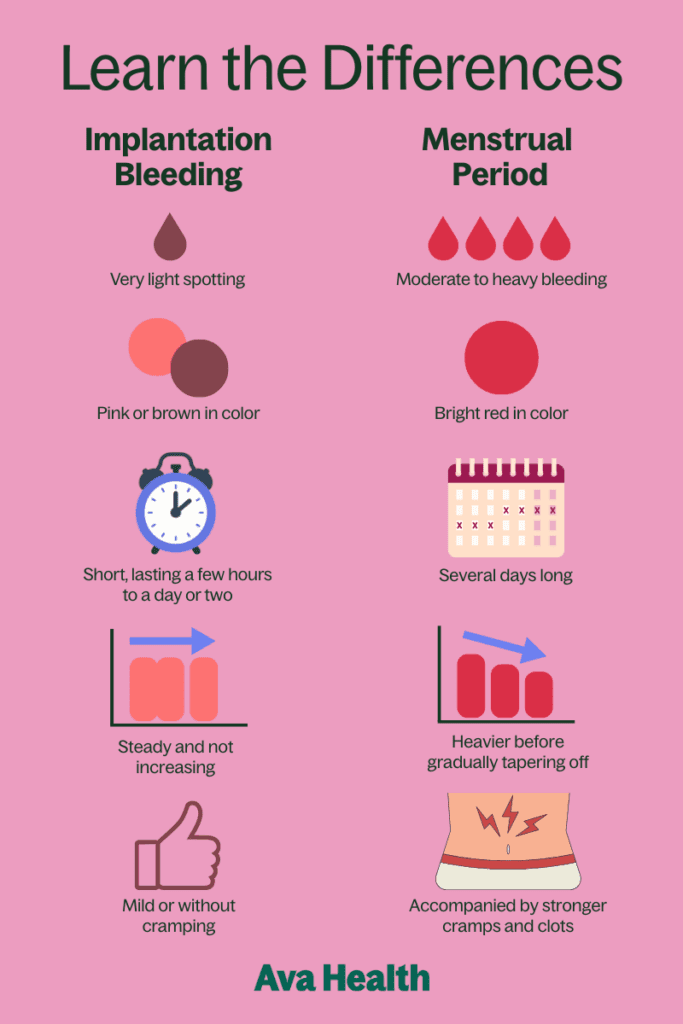
Implantation bleeding vs. a period: ways to tell the difference
Every woman’s body is unique, but these patterns are often helpful when you’re trying to make sense of what you’re seeing.
Implantation bleeding is often:
- Very light spotting
- Pink or brown in color
- Short, lasting a few hours to a day or two
- Steady and not increasing
- Mild or without cramping
A period is more likely to be:
- Moderate to heavy bleeding
- Bright red in color
- Heavier before gradually tapering off
- Several days long
- Accompanied by stronger cramps or small clots
If bleeding is heavy enough to soak through a pad or tampon, it’s unlikely to be implantation bleeding. For more information, check out: Can You Be Pregnant and Still Have a Period?
Can implantation bleeding and a period happen at the same time?
No — implantation bleeding is not a period.
If pregnancy has occurred, a true menstrual period will not follow. That said, bleeding during early pregnancy can happen, which is why this can feel confusing and concerning.
If you’re wondering whether pregnancy and bleeding can overlap, learning more about how early pregnancy works may help bring clarity.
Can implantation bleeding be heavy?
Implantation bleeding is usually light.
Bleeding that is:
- Bright red
- Heavy
- Increasing over time
- Or painful
is more likely related to a period or another cause. It’s important not to assume heavier bleeding is implantation bleeding.
When is the best time to take a pregnancy test?
Because implantation bleeding can happen before pregnancy hormones rise, a test taken too early may still be negative.
For clearer results:
- Wait until after a missed period
- Use first-morning urine if possible
- Consider testing again a few days later if pregnancy is still a possibility
If test results feel confusing or don’t match how you’re feeling, learning more about how pregnancy tests work can be reassuring. Check out: How Pregnancy Tests Work to learn more about when the best time to take a pregnancy test is.
What if you’re still not sure what this bleeding means?
Uncertainty can feel heavy, especially when your body isn’t giving clear answers right away. You don’t have to sort it out alone.
It may be helpful to reach out to a healthcare provider if:
- Bleeding feels heavy or painful
- You have a positive pregnancy test and notice moderate to heavy bleeding
- Symptoms feel unusual for your body
- You’re feeling worried or unsettled
Clear, compassionate care can make an uncertain moment feel more manageable.
Quick Takeaways
Implantation bleeding and periods can start out looking similar, but they are not the same.
Implantation bleeding is usually:
- Light
- Brief
- Does not increase
A period is typically:
- Heavier
- Longer
- Follows a more familiar pattern
If you’re unsure, giving your body a little time and testing again often brings clarity. Whatever you’re facing, support and trustworthy information are available — and you deserve both as you take your next step.

Sources
Lewis, Rhona. “Implantation Bleeding vs. Period: How to Tell the Difference.” Healthline, 14 May 2025,
https://www.healthline.com/health/implantation-bleeding-vs-period. Accessed 26 Jan. 2026.“Implantation Bleeding: 4 Signs to Watch for.” Health.com, 29 June 2024,
https://www.health.com/implantation-bleeding-vs-period-8665982. Accessed 26 Jan. 2026.“Implantation Bleeding vs. Period: How to Spot the Difference?” Thomson Medical, 11 Sept. 2025,
https://www.thomsonmedical.com/blog/implantation-bleeding-vs-period. Accessed 26 Jan. 2026.“Implantation Bleeding: Causes, Symptoms & What to Expect.” Cleveland Clinic,
https://my.clevelandclinic.org/health/symptoms/24536-implantation-bleeding. Accessed 26 Jan. 2026.“Implantation Bleeding vs. Period: How Do You Tell the Difference?” eMedicineHealth,
https://www.emedicinehealth.com/implantation_bleeding_vs_period/article_em.htm. Accessed 26 Jan. 2026.
Share this Blog
Disclaimer: The content on this site is for informational purposes only and does not constitute medical advice. Ava Health does not refer for or perform abortions. All medical information is accurate at the time of publishing.
Other Articles You Might Be Interested In