Can You Be Pregnant and Still Have a Period? (What Bleeding Really Means)
- Medically Reviewed
- Last Updated
The short answer: Yes, you can have bleeding and still be pregnant—but it’s not a true period.
Want to get clarity fast?
Schedule an appointment with Ava for a free pregnancy test and know for sure whether you’re pregnant.
Maybe you noticed light bleeding when your period was due. Maybe your flow was lighter than usual. Or maybe you missed your period altogether and now you’re wondering if that spotting means you’re not pregnant after all.
In this guide, we’ll explain what’s really going on, how to tell the difference between early pregnancy bleeding and a period, what early pregnancy symptoms to watch for, and when to take a pregnancy test or see a healthcare provider.
How does pregnancy affect my period?
To understand why a real period can’t occur during pregnancy, it helps to know how the menstrual cycle works.
- Each month, your body prepares a possible pregnancy by thickening the lining of the uterus
- When an egg is released during ovulation and is not fertilized, hormone levels drop and that lining is shed — that’s your menstrual period.
- If fertilization does happen, your body gets a new message. Instead of shedding the lining, it maintains it to protect and nourish a developing embryo.
- Hormones like hCG, estrogen, and progesterone rise to support this process.
- As a result, your period stops for the duration of pregnancy.
So, if you’re pregnant and still notice bleeding, it’s not a true menstrual period. But that doesn’t mean something is necessarily wrong — there are several reasons for light bleeding or spotting that might occur early in pregnancy.
Why am I bleeding in early pregnancy?
Here are the most common causes of bleeding during early pregnancy:
Implantation Bleeding
When a fertilized egg attaches to the lining of the uterus, small blood vessels can break, causing light spotting or a small amount of bleeding. This usually happens 6 to 12 days after ovulation, often around the time your period would normally start. Implantation bleeding is typically very light and short-lived — just a few drops or a day or two of pink or brown discharge.
Hormonal Changes
Early pregnancy brings big hormonal shifts, especially in progesterone and estrogen levels. These changes can cause light spotting, cramping, or changes in discharge. Hormonal fluctuations can also make your breasts feel tender and your emotions feel heightened.
Cervical Irritation
During pregnancy, the cervix becomes more sensitive and filled with extra blood vessels. Intercourse, a pelvic exam, or even minor irritation can cause light spotting. This type of bleeding is usually nothing to worry about, but it’s always okay to check in with your provider for reassurance.
Subchorionic Hematoma
A small pocket of blood between the uterine wall and the gestational sac can sometimes cause light to moderate bleeding. In many cases, these resolve on their own without affecting the pregnancy.
Infections or Inflammation
An infection of the cervix, uterus, or vagina — or inflammation from irritation — can sometimes cause light bleeding. These issues can usually be treated by your provider.
Other Conditions
Other conditions like miscarriage or ectopic pregnancy can cause bleeding. If you are experiencing pain in your shoulder or back along with bleeding, it’s time to see a doctor, as this could be serious.
Difference between period and pregnancy bleeding?
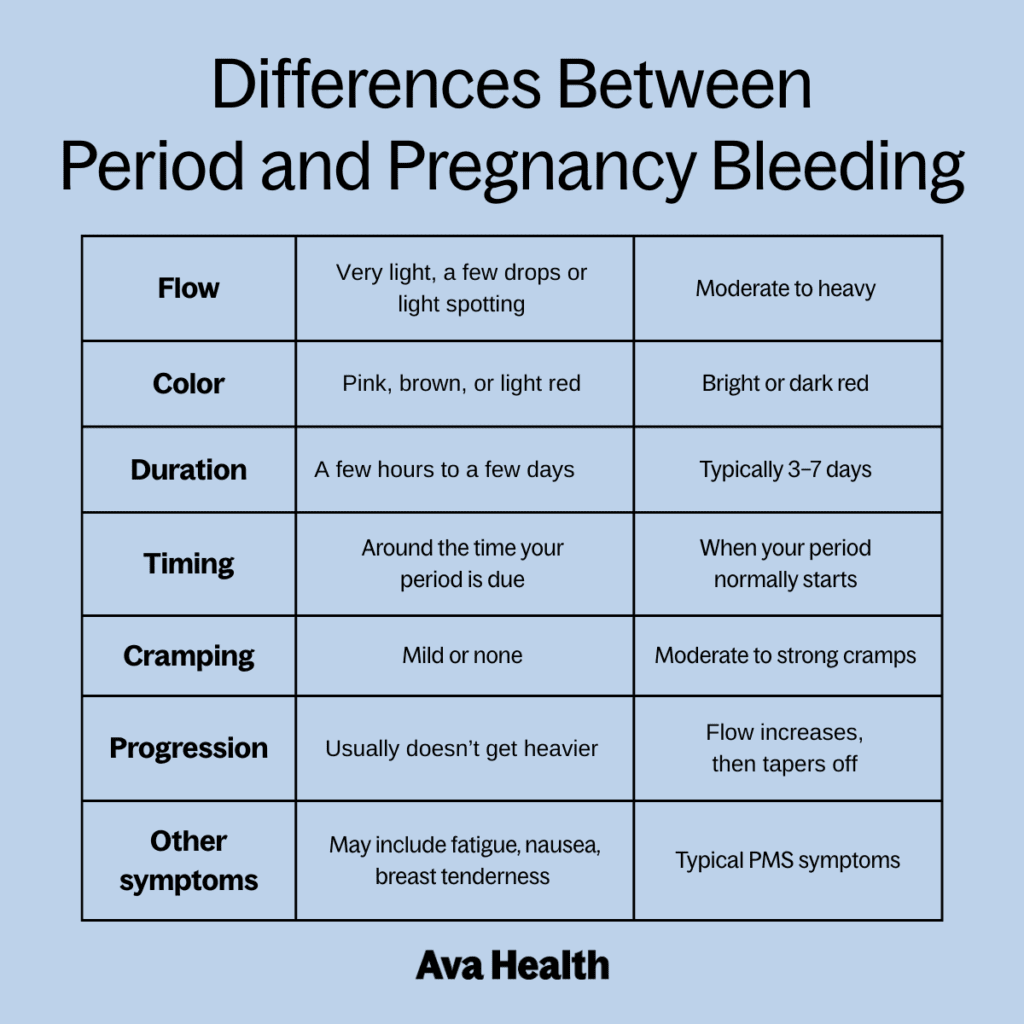
Since early pregnancy bleeding can look like a light period, it’s easy to get confused. Here’s how to tell the difference.
- Flow: Pregnancy bleeding will be very light, while your actual period will be moderate to heavy.
- Color: Pregnancy bleeding should be pink, brown, or lighter red, and your actual period, will be vibrant or dark red colors.
- Duration: Pregnancy bleeding is very short; it only lasts a few hours to a few days at most. Your period can be anywhere from 3-7 days.
- Timing: Pregnancy bleeding and period bleeding can happen around the same time, so it’s important to look at the other factors.
- Cramping: Most women say that pregnancy bleeding only caused very little to no cramping, whereas period cramping is a lot stronger.
- Progression: Pregnancy bleeding will start off light, and then go away. Period bleeding can start light, get heavier, then eventually taper off after multiple days.
- Other symptoms of pregnancy bleeding and your period may overlap, but the key difference is that your PMS symptoms will intensify and then go away as your period ends, whereas pregnancy bleeding might be the beginning of prolonged fatigue, nausea, and breast tenderness, as your pregnancy progresses.
Any one of these symptoms by itself is not enough to determine what’s happening. It’s best to look at the full picture, such as how long your symptoms have been happening in conjunction with how intense the bleeding is, etc.
What are other common signs of pregnancy?
Early pregnancy symptoms can look and feel a lot like PMS, which is why so many women are unsure until they test. However, a few key differences can help you tell them apart.
- Missed Period
A missed period is often the first sign of pregnancy. If your cycles are regular and your period is late, it’s a good idea to take a test.
- Light Spotting or Implantation Bleeding
Light spotting that happens before or instead of your usual period could be implantation bleeding — one of the earliest signs of pregnancy.
- Fatigue
You might feel unusually tired as your body works overtime to support early development.
- Nausea or “Morning Sickness”
Some women begin to feel queasy as early as two weeks after conception. This can happen at any time of day and may come with food aversions or heightened sensitivity to smells.
- Breast Changes
Hormonal changes cause the breasts to feel swollen, sore, or tingly. The area around the nipples (areolas) may darken.
- Frequent Urination
As hormones increase blood flow to the kidneys, you may need to use the restroom more often.
- Bloating and Mood Swings
Early pregnancy hormones can cause bloating, mood changes, and even mild cramps that resemble pre-period symptoms.
- Heightened Smell or Taste Changes
Many women notice strong aversions to certain foods or smells — even favorites they once enjoyed.
If you experience several of these symptoms along with a missed period or spotting, it’s time to take a pregnancy test.
When should I take a pregnancy test?
Timing matters when it comes to pregnancy testing.
- Most home pregnancy tests can detect the hormone hCG about 10 to 14 days after conception, or roughly when your period is due.
- Testing too early can lead to a false negative because your hCG levels might not be high enough yet.
- If your first test is negative, but your period still doesn’t arrive within a few days, retest or schedule an appointment for a lab test.
At Ava Health, we offer free urine pregnancy tests that provide fast, confidential results and next-step guidance — all at no cost.
Is bleeding in early pregnancy a concern?
While light spotting is often harmless, some signs require immediate medical attention. Contact your healthcare provider or go to the emergency room if you experience:
- Heavy bleeding that saturates 2 pads/hour and that goes on for over 2 hours
- Severe or persistent abdominal pain
- Passing clots or tissue
- Dizziness, fainting, or shoulder pain
- Fever, chills, or foul-smelling discharge
- Bleeding later in pregnancy (second or third trimester)
These could indicate miscarriage, ectopic pregnancy, or another complication that needs urgent care.
What will my provider do if i'm bleeding and I think I'm pregnant?
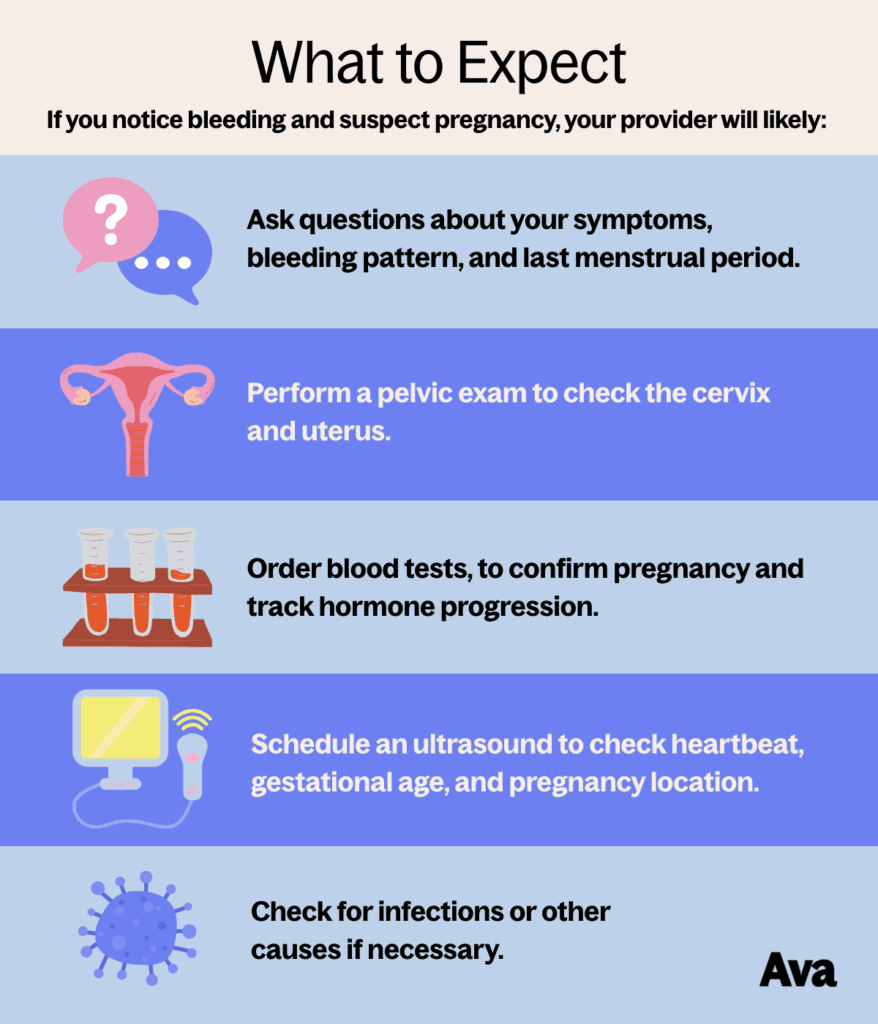
If you notice bleeding and suspect pregnancy, your provider will likely:
- Ask questions about your symptoms, bleeding pattern, and last menstrual period.
- Perform a pelvic exam to check the cervix and uterus.
- Order blood tests, especially hCG levels, to confirm pregnancy and track hormone progression.
- Schedule an ultrasound to check for fetal heartbeat, gestational age, and ensure the pregnancy is in the uterus.
- Check for infections or other causes if necessary.
These steps help confirm whether your pregnancy is progressing normally and rule out any concerns.
What can I do at home?
If you’re experiencing bleeding or suspect pregnancy, here are simple steps to care for yourself while waiting for clarity:
- Track your symptoms. Note when the bleeding started, how long it lasts, the color, and how heavy it is.
- Take a pregnancy test if your period is late.
- Avoid strenuous activity until you’ve spoken to a provider.
- Skip sexual activity until the bleeding stops or a provider clears it.
- Rest and hydrate. Your body needs extra energy whether you’re on your period or your body is preparing for pregnancy.
- Seek support. If you’re feeling anxious, talk to someone you trust or connect with a pregnancy clinic like Ava Health.
FAQs
Can you have a normal period while pregnant?
No. True menstrual bleeding only happens when the uterine lining is shed — something that doesn’t occur during pregnancy.
Is implantation bleeding heavy?
No. Implantation bleeding is typically light and brief — sometimes so light you might only notice it once when wiping.
Does bleeding during pregnancy mean miscarriage?
Not always. Many women have light spotting and go on to deliver healthy babies. Still, any bleeding should be checked out.
Can you get pregnant if you’re bleeding?
While it’s unlikely to conceive during active bleeding, it’s possible to ovulate early or late in your cycle, which can make timing unpredictable.
Are pregnancy tests reliable?
When taken correctly and at the right time, modern pregnancy tests are very accurate. For the most dependable result, use the first urine of the morning or get tested at a clinic.
Why does it matter to know the difference between a period and pregnancy bleeding?
Learning the difference between a true period and early pregnancy bleeding is more than just a medical detail — it helps you care for your health, make informed decisions, and feel confident about what’s happening in your body.
- It reduces confusion when your cycle changes unexpectedly.
- It helps you catch pregnancy early, so you can decide your next steps.
- It protects your health by identifying red-flag symptoms that need attention.
What are some real-life scenarios?
Scenario 1: Spotting Around Period Time
You expect your period but notice only light pink spotting. You take a test and find out you’re pregnant — the spotting was from implantation.
Scenario 2: Heavier Bleeding and Cramping
You experience heavier bleeding and back pain. The test is positive, but an ultrasound shows a miscarriage.
Scenario 3: Sharp Pain and Dizziness
You feel sharp pain on one side and light bleeding. At the clinic, based on testing, your obstetrician diagnoses an ectopic pregnancy.
Each experience is unique. The important takeaway: don’t ignore unusual bleeding — get checked and know what’s happening in your body.
What do I do next?
If you think you might be pregnant or are noticing unexplained bleeding, you don’t have to navigate it alone.
At Ava Health, we offer:
- Free pregnancy testing
- Limited obstetric ultrasounds to confirm pregnancy and estimate gestational age
- Confidential consultations with licensed medical staff
- Education for your next steps
Our team provides care in a compassionate, judgment-free environment. We’re here to help you find clarity and confidence as you make informed decisions about your health.
You can learn more or schedule an appointment at avahealthpdx.org.
TL;DR
- You cannot have a true period while pregnant, but light bleeding or spotting can occur for other reasons.
- Implantation bleeding, hormonal changes, or cervical irritation are the most common causes of early bleeding.
- Any heavy bleeding, pain, or dizziness should be evaluated by a healthcare professional right away.
- Early pregnancy symptoms like fatigue, nausea, breast tenderness, and a missed period are often the first clues.
- If you think you might be pregnant, take a test and contact Ava Health for free, confidential support.
Share this Blog
Disclaimer: The content on this site is for informational purposes only and does not constitute medical advice. Ava Health does not refer for or perform abortions. All medical information is accurate at the time of publishing.
Medically Reviewed By:

Anka Radutiu, BSN, RN
Other Articles You Might Be Interested In


I Think I Might Be Pregnant: What to Do Before You Take a Test