
Creating a Birth Plan with Adoption: What to Know
- Last Updated
It’s completely valid to feel both hopeful and uncertain as you consider how to build a birth plan that includes adoption. You’re taking an important and compassionate step by planning ahead. You’re not alone—and you’re fully capable of making a thoughtful choice that reflects your voice, your values, and your future.
What to Know First: Why a Birth Plan Matters When Adoption Is Part of the Story
Before diving into the details of what to include, it helps to understand why your birth plan matters—especially when you’re considering adoption.
- A “birth plan” in this context is your written or verbal document that outlines your wishes for labor, delivery, recovery, newborn care—and in your case, how adoption will be integrated into those moments. For expectant mothers considering adoption, the plan becomes a tool of empowerment, clarity, and self-advocacy.
- Because adoption introduces additional variables (like involvement of adoptive family, timing of placement, first moments with baby, contact arrangements), having your preferences clearly recorded ahead of time ensures your voice is heard during what can be a very emotional time.
- A good birth plan empowers you to speak up, to ask questions, and to feel prepared. It doesn’t lock you into a rigid schedule—it simply gives you a roadmap while acknowledging that unexpected moments happen.
- By aligning your birth plan with your adoption journey, you honor yourself, your baby, and your path forward. You’re asserting that this experience is yours too—not just about logistics but about your dignity and care.
Your Step-by-Step Guide: Creating Your Birth Plan That Includes Adoption
Here’s an example pathway to help you build your plan. You don’t need to fill everything out at once. Go at your pace. Your voice matters.
- Begin with Reflection: Your Values, Needs, and Hopes
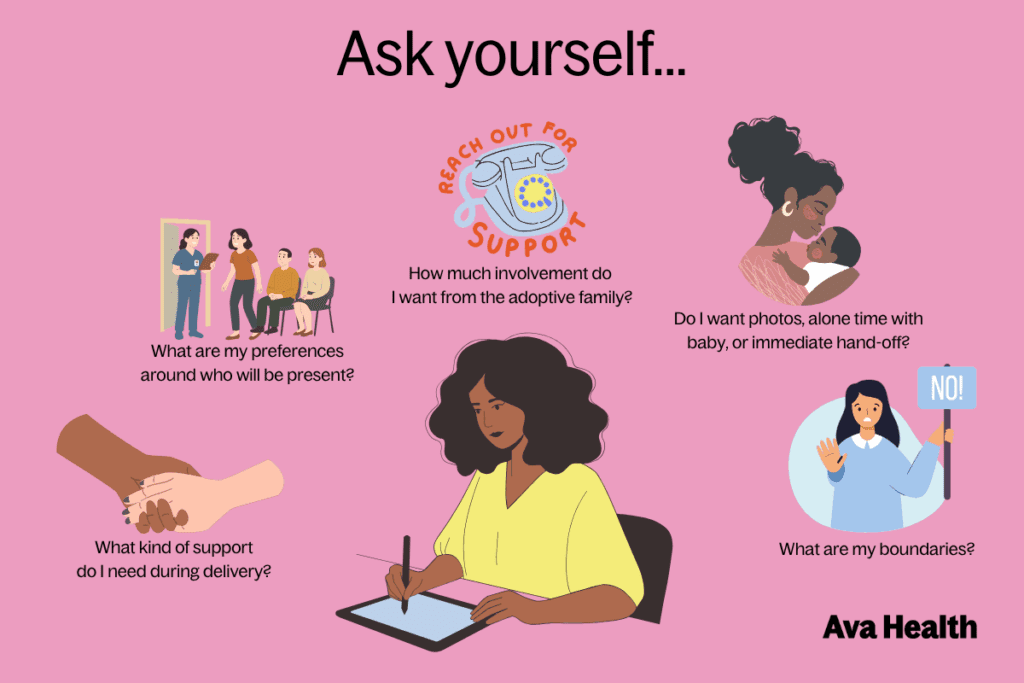
Take a quiet moment and ask yourself:
- What kind of support do I need during labor and delivery? (emotional, physical, spiritual)
- What are my preferences around who will be present?
- How much information or involvement do I want the adoptive family to have during or after the birth?
- Do I want photos, time alone with baby, visits, or immediate hand-off?
- What are my boundaries—what feels right or not right to me?
When you answer these questions, you’re giving yourself a foundation for your birth plan that aligns with your beliefs.
- Choose Your Support Team & Birth Environment
Your birth plan can include specifics like:
- Who you want by your side (partner, friend, mother, doula, counselor)
- Who you prefer not to have present
- The environment you prefer (private room, filtered lighting, music soft, specific comfort items)
- The presence of the adoptive family: Would you like them in the room? Waiting outside? After?
Agencies that specialize in adoption note that your preferences around the adoptive family’s presence are your choice entirely.
In your pregnancy check-ups, discuss these environment goals with your healthcare provider and agency so everyone understands your vision.
- Labor & Delivery Preferences
Though birth never follows a perfect script, having clarity around your preferences helps you feel more grounded. Your plan might include:
- Pain management preferences (epidural, natural, combination)
- Preferred delivery positions (lying down, side, kneeling, water birth)
- Monitoring or interventions you’d prefer to avoid if safe (continuous vs intermittent fetal monitoring)
- Preferences for how the adoptive family is involved at the moment of birth (present for first cry? wait until you rest?)
- If you want time with the baby right after birth—being held, skin-to-skin, photography, etc.
Agencies encourage birth mothers to include flexibility and “what if” scenarios. For example: “If a cesarean (c-section) is needed, I would like…”
- Baby Care & Adoption-Specific Details
Because you’re integrating adoption, this section becomes particularly meaningful. Consider including:
- How long you’d like to hold or be with your baby before the adoptive parents take over
- Would you like the adoptive parents present when you first hold the baby, or to wait?
- How you’d like the “handoff” to be: private moment, pictures, brief visit, etc.
- Would you like to take photos, write a letter, have keepsake items?
- Will you be present when the adoptive parents take baby home, or would you prefer to discharge separately?
These are your choices—and you are entitled to decide them ahead of time.
Make sure your adoption agency and hospital staff receive a copy of your preferences so your wishes are known.
- Contact & Communication Preferences After Birth
Depending on which type of adoption plan you’ve chosen (open, semi-open, closed) your birth plan can state how much contact you expect or hope for:
- Would you like updates from the adoptive family (photos, letters, videos)?
- Would you like a visit in the future? If so, how often and under what circumstances?
- Would you prefer minimal or no contact? That’s okay too—your comfort matters.
Writing this into your plan helps set expectations and clarity between you, the adoptive family, and the agency.
Flexibility is important: you could say “I would like updates but know this may evolve over time.”
- Hospital Stay & Post-Discharge Preferences
Your plan can outline what you’d like for your hospital stay and after:
- How long you plan to stay in hospital after baby is born
- Would you like a private room, or shared?
- Who you’d like to visit or not visit after birth
- Do you want to breastfeed? Bottle-feed?
- Post-birth care for you: would you like counseling, peer support, a follow-up plan with agency?
Your birth plan is also about you, not just the baby or adoption. Including your emotional and physical recovery matters.
- Backup Plan & Flexibility
Because births don’t always go as planned, your birth plan should include a short paragraph for “if things change” such as:
“If a cesarean section (c-section) is needed, I would like [preference]. If I am not able to hold my baby immediately, I would like [preference].”
This gives you peace of mind knowing your voice is heard even when surprises arise.
Many agencies recommend this for birth mothers choosing adoption.
How to Format & Share Your Plan
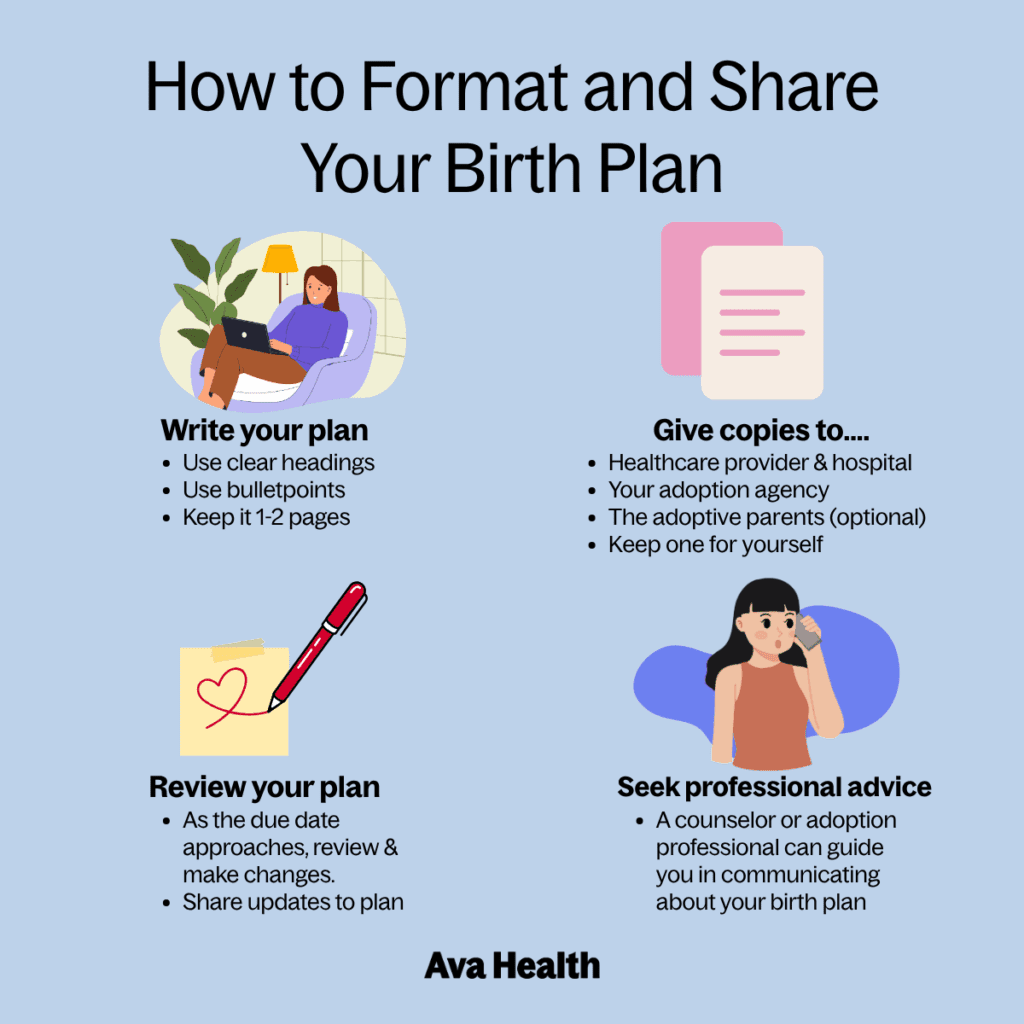
- Use clear headings, bullet points, keep it to one or two pages if possible (so hospital staff can quickly review).
- Give copies to: your healthcare provider, hospital, your adoption agency, the adoptive parents (if desired), and keep one for yourself.
- Review it near your due date and share any updates.
- Speak with your counselor or adoption professional about discussing the plan with the adoptive family and hospital social workers.
Time to Pause
You are fully worthy of creating this “birth-with-adoption” plan. You’re exercising strength, clarity, and love. It doesn’t diminish your role—it honors it.
Whether you choose to be more involved with the adoptive family or you prefer quieter distance, your comfort, well-being and peace matter deeply.
Your birth plan is your voice made visible. It declares: This is how I want to experience the birth. This is how I want to remember it. This is how I want to step into the next chapter.
You deserve support, understanding, and a safe space to make these decisions. Your journey matters.
Reflection & Next Steps
Take a quiet moment now:
- What one or two preferences in your birth plan feel most important to you?
- Which part of your plan feels the most emotional? The most empowering?
- Who will you share your plan with this week?
- What’s one question you can ask your adoption counselor or healthcare provider about your plan?
You’re not alone in this. You’re choosing with courage. You’re writing the blueprint of a meaningful birth and adoption story.
Other Resources
For further reading and support from Ava Health, you may find these resources helpful:
- Adoption 101
- How to Talk to an Adoption Agency
- Open vs. Closed Adoption
- What different Adoption Plans mean for the Birth Mother
- How long does Adoption Take?
Note: This blog post is for informational purposes only and does not constitute legal advice. For personalized guidance, please consult with a licensed adoption professional or attorney.
Share this Blog
Disclaimer: The content on this site is for informational purposes only and does not constitute medical advice. Ava Health does not refer for or perform abortions. All medical information is accurate at the time of publishing.
Other Articles You Might Be Interested In